
Happy New Year 2024 from us at Dalang Publishing

Happy New Year 2024 from us at Dalang Publishing
Born in Lipulalongo, a small village of clove growers in Central Sulawesi, Erni Aladjai earned her degree in French literature from the Hasannudin University in Makassar, Sulawesi. She has worked as a journalist and news editor in Makassar.
Several of her poems, essays, and short stories have been published by local as well as national media. Aladjai’s short story Mariantje dan Pasangan Tua first appeared in the Media Indonesia newspaper on April 21, 2013 and was republished in 2014 along with its translation, Mariantje and the old Couple on Dalang Publishing’s website. Her novel, Kei (Gagas Media 2013), took first place in the 2011 Jakarta Arts Council novel competition and was translated under the same title by Nurhayat Indriyatno Mohamed (Dalang Publishing 2014). Other award-winning works include “Sampo Soie Soe, Si Juru Masak” placed third at the 2012 Jakarta International Literary Festival. Her two novellas, Rumah Perahu and Sebelum Hujan di Seasea, took second and third place in the 2011 Femina Writers Competition. Aladjai is also the author of the novels Ning di Bawah Gerhana (Bumen Pustaka Emas, 2013) and Pesan Cinta dari Hujan (Insist Press, 2010).
Aladjai is currently a full-time writer and a freelance fiction editor. She can be reached at: erni_aladjai@yahoo.com
Bab 8
Langgur, Awal Mei 1999
Angin laut lebih gigil dari bulan-bulan kemarin. Di bibir Pantai Langgur, para lelaki tua dan pemuda berdiri berjejer. Suasana mencekam. Dari jauh, tiga buah sampan dengan nyala lentera meliuk-liuk menuju ke bibir Pantai Langgur.
“Semua siap siaga!” perintah Tinus — lelaki berumur 45 tahun itu adalah pembantu raja di bidang hukum dalam tatanan adat. Para lelaki menahan napas sejenak saat sampan-sampan itu mendekat. Semakin sampan mendekat, suara kecipak dayung mereka semakin terdengar jelas. Tiba-tiba salah satu dari mereka mengangkat lampu lenteranya dan berdiri.
“Oooii yaau ya…!” Sosok yang berteriak itu ternyata seorang perempuan berkerudung.
“Apakah kami bisa masuk, kami membawa makanan dan pakaian untuk keluarga kami yang mengungsi di situ,” ujar salah seorang di dalam perahu. Mereka datang membawakan bantuan makanan untuk saudara-saudara mereka yang mengungsi.
“Ya, saudaraku, kalian bisa masuk dengan aman,” seru Tinus.
Semua lega, ternyata mereka bukanlah para penyerang, bukan pula huin demuan — orang-orang penghasut kerusuhan. Tujuan mereka untuk mengguncang Maluku, tetapi di Kei, baik Islam atau Kristen, sama-sama tetaplah orang Kei.
Para lelaki mengantarkan tiga perempuan itu ke tenda pengungsian. Di sana mereka berpelukan dengan kerabat mereka.
“Kalian jangan sedih, tenang-tenang saja dulu. Kami yakin rusuh ini pasti berhenti. Dan kita bisa bersama lagi. Untuk sementara kami tak bisa lama-lama, kalian mengerti, kan? Ini hanya untuk sementara,” kata perempuan yang bersampan itu sembari menghapus air mata kakak kandungnya.
Kekerabatan orang Kei memang sangat kompleks. Banyak orang Islam menikah dengan orang Kristen. Jadi, jika sang nenek Islam, bisa jadi anak dan cucunya Kristen. Sang suami Kristen, bisa jadi istrinya Islam, atau jika sang kakak Islam, bisa jadi adiknya Kristen atau sepupunya Katolik. Karena itu juga, semua orang Kei bersaudara. Kompleksitas kekerabatan di Kei sama rumitnya dengan irama lagu Bohemian Rhapsody yang dilantunkan grup musik legendaris Queen.
Di hati orang Kei bersemayam snib — wasiat leluhur mereka, yang selalu mengajarkan untuk menjaga, melindungi dan menghormati kaum perempuan. Mereka akan dilindungi lelaki Kei di mana pun, siapa pun dia dan penganut agama apa pun. Pengiriman bantuan makanan yang dibawa tiga orang perempuan yang bersampan itu biasa di Kei, sebab perempuan tahu, mereka tak akan disakiti.
*****
Untuk membaca cerita ini secara lengkap silakan membeli bukunya melalui: https://gagasmedia.net/buku/k-e-i/
Nurhayat Indriyatno Mohamed is the managing editor of the Jakarta Globe, an English-language newspaper in Jakarta. He was born and raised in Tanzania, and has a degree in mechanical engineering from the University of Natal, Durban, in South Africa. At age 24 Hayat decided to move to Indonesia, the land of his father’s birth, and was immediately smitten by the novelty of it all.
A chance encounter led to a newspaper job, and another presented him with the opportunity to translate into English a book by the award-winning author Okky Madasari. Hayat translated Erni Aladjai’s award winning novel Kei (GagasMedia 2013) under the same title for Dalang Publishing in 2014.
Hayat can be reached at: hayat.indriyatno@yahoo.com
Chapter 8
Langgur, May 1999
The wind from the sea was colder than in previous months. Old and young men lined up on the beach. In the distance, a group of three rowboats lit by lanterns snaked their way closer to the shore.
“Everyone get ready.” At forty-five, Tinus was the tribal leader’s assistant for legal matters. The men held their breath as the rowboats approached. As they drew closer, the sound of the oars churning the water grew clearer. Someone in one of the boats held a lantern aloft and stood up.
“Hey, brothers, we are here,” shouted a woman wearing a jilbab.
“Can we come ashore? We have food and clothes for our families taking refuge here,” another person in the boat said.
“Yes, my brothers and sisters, you can come ashore,” Tinus called out.
Everyone was relieved. They were not attackers or people trying to instigate violence. The latter were out to destabilize Maluku, but on Kei, whether Muslim or Christian, everyone was still a Kei.
The men escorted three of the women from the rowboat to the refugee camp. Once there, they embraced their relatives. “Don’t be sad, just calm down. The conflict will end soon and we can be together again. We can’t do anything for now, do you understand? This is only temporary.” One of the women wiped the tears from her sister’s eyes.
The personal ties among the Kei people had always been complex. Many Muslims married Christians, so if a woman was a Muslim, her grandchild could very well be a Christian. A Christian husband could have a Muslim wife, and a Muslim’s sibling could be Protestant and their cousin Catholic. That was part of the reason why the Kei were brothers. Their relationships were as complex as the arrangement of the song “Bohemian Rhapsody” by Queen.
In the heart of the Kei lived snib — a sacred legacy of the ancestors to always guard, protect, and respect women. Kei men had to protect women everywhere, no matter who they were or what religion they followed. The bringing of food by the women in the rowboats was common in Kei. They knew they would never be hurt.
***
Long before the conflict came to the Kei islands, the people had built churches and mosques together. Catholics, Protestants, and Muslims alike joined in cheerfully. The Kei had a life philosophy: we are all eggs from the same fish and the same bird. Their traditions and tribal laws dated back to historic times, prevailing through the years and superseding all else, including religious doctrine.
When the conflict started in Ambon in January 1999, the Kei stayed calm and refused to take sides. Then on March 31, just before daybreak, violence erupted in Tual. The Kei people learned about it from television and radio reports after the sun had risen high in the sky. Most of them following the developments were convinced the conflict would never leap to the Kei islands. An imam at a mosque said: “The traditional laws of Kei come first. Only after that do people heed the Qur’an or the Bible. The last law we obey is the law of the State of Indonesia.”
The conflict was crueler than the angel of death. It spread quickly to the small villages and islands in the area, reaching Elaar and Watraan and other places.
As the conflict escalated, the tribal leaders and settlers — the Buginese, Javanese, Makassarese, Buton, and Chinese — gathered to talk about peace.
***
Namira was trying to calm two young boys at the refugee camp who were arguing and trying to snatch each other’s marbles when Sala came along carrying a pair of yellow flip-flops. He knew she had not worn footwear since he first met her, and did not want her stepping on any more glass shards. Since the night at Max’s house, Sala’s love for Namira had grown by the day. He abandoned his plan of leaving the Kei islands. He wanted the conflict to be over quickly so he could take Namira to Watraan. He wanted to marry her there.
Sala imagined that after a tiring day of forging knives, she would bring him a cup of tea and a plate of fried cassava. His daydreams were filled with the small pleasures of married life. He believed his mother’s soul would be at peace if he went back home and revived the metal shop.
Namira was all the encouragement he needed.
At lunch at the camp, Namira busied herself preparing Sala’s food. It became the talk of everyone working in the kitchen. The volunteers called her and Sala the Romeo and uliet of Langgur. It annoyed and pleased Namira.
“He’s a good man, Ra,” said Rohana. She was short and fat, with round cheeks, and always joking and cheerful.
Namira liked Rohana, and so did many of the other refugees. She told funny stories that made the others laugh as though the violence in Kei had never happened.
One day, the volunteers and social workers were upset because the food aid sent by the government had spoiled. The bread was moldy and the instant noodle packets were torn and infested with ants. Seeing the others upset, Rohana started to chatter.
“A young man named Lius went to the same food stall at lunchtime. One day he asked the woman owning the stall, ‘Aunty, what stew do you have?’
“The owner said, ‘Nail stew, Lius.’
“He ordered the nail stew. The next day he came again at lunchtime. He asked, ‘Aunty, what stew do you have?’
“The woman answered, ‘Bamboo stew, Lius.’
“Then Lius said, ‘Aunty, if this keeps up, tomorrow I’ll
shit a fence.’
”Another time, when the volunteers were gloomy because of news that the military had entered the conflict in Maluku, Rohana had another funny story to tell. She said that when people complain, things only get worse because the universe repays them with more grief. “So let go and laugh,” she said.
The story went like this: A child went home after he was scolded by his teacher at school and told his grandfather. The grandfather became angry and went to the school looking for the teacher. But when he arrived, the teacher had gone home. The grandfather became angrier and went to the teacher’s house. He rolled up his sleeves, revealing his tattoos. When he knocked on the teacher’s door, a soldier in full uniform answered. The soldier was the teacher’s husband. The grandfather suddenly turned coward.
The soldier asked, “Can I help you, pak?”
The grandfather answered, “I wanted to ask the teacher if there was community service at the school today.”
Rohana was endearing to Namira, Sala, other volunteers, and the refugees.
***
Sala touched Namira’s leg. She woke and rubbed her eyes.
“Sorry.” He felt bad waking her up before daybreak.
Namira rose and went to the well. She washed her face and tied her hair back while Sala waited for her. They walked to the ketapang tree and stood so close they formed a single silhouette. Moonlight seeped between the leaves and branches, and fell in a straight line across the ground. Sala pulled Namira into an embrace. He felt uneasy, yet wished he could spend all of his time showing her his love.
A moment later, they headed toward the road and the beach. They walked through patches of beach morning glory and gravel before they reached the white, wet sand. Namira brought a fish basket and Sala carried a set of oars. The village chief ’s boat was moored on the beach. It was used for fishing so there would be food for the refugees.
“I don’t have a good feeling about today. Maybe you should stay on land,” Namira said. Besides her premonition, she had a vision of corpses floating on the water and the fish nibbling on them. She shuddered to think people ate the same fish.
Namira looked at Sala, her intuition tied up in knots. She took the fish basket back out of the boat and Sala followed her.
Deep in his heart, he felt the same. Martina had told him that a woman’s intuition is stronger than a fortuneteller’s prediction.
***
“Not going out to sea today, pela?” a volunteer asked.
“No, Namira won’t let me.”
When the sun was directly overhead, the sound that had haunted everyone for the past two months returned. It was heard in Elaar, Watraan, and Ngursoin. The refugees scattered. Once again, there was crying and the noise of gunshots. A mob appeared from nowhere and surrounded Langgur, like “rats that suddenly appear from unknown holes, right at the eruption of war.”
These unknown rats came with machetes, spears, and arrows. This was the most sorrowful conflict of all — against one’s brothers.
A bomb exploded north of Langgur and shook the ground. It felt as though the village would split apart. The refugees ran every direction. Namira could only sit with her wet cheeks and cover her ears. The trauma she experienced in Elaar made her unable to move.
“Those goddamned police and soldiers. Where did these people get their guns if not from them?” One of the volunteers cursed aloud and added, “This is truly crazy.”
Langgur’s main street was divided. To the right were the local men and refugees, and to the left the attackers who barricaded the road. The parties threw rocks at each other and the attackers shot arrows that showered the other side like shooting stars.
The road was strewn with rocks. A food kiosk close to Max’s house caught fire. Three men lay still on the road. No one helped them. Sala broke through the blockade of men wearing red bandanas. Namira was left behind and hid with another volunteer beside a rusty barrel. A man wearing a red bandana pointed his spear at them.
Namira broke out in a cold sweat.
“Are you Muslim?” he asked.
Namira trembled. The volunteer next to her shut her eyes tight, ready to meet her barbaric end with dignity.
“Hey, pela, don’t you hurt those girls or you’ll get hurt yourself.” A voice like a tiger’s roar pierced Namira’s ears. Sala stood in front of the man with the red bandana. “I won’t fight you, pela. I don’t want to give those seeking bloodshed any reasons to cheer.”
Namira looked intently at Sala.
The volunteer babbled, “Oh, Allah, Jesus, Elohim, Hallelujah, Dalai Lama, gods of the sky, bring peace to Kei.”
Sala stepped up to the man with the spear.
“I’m the same as you, I have the same religion. But if we join in the slaughter, we’ll only satisfy those who want to see chaos in Maluku,” Sala said.
It was like a miracle. The man with the red bandana was quiet. He had only been paid to do something that he was reluctant to do. Sala pulled Namira by the arm. She collapsed in his embrace, sobbing. “Please find Esme,” she said between tears.
***
Black smoke blanketed Langgur and the other villages, resembling a flock of crows passing overhead. The stench of death was like the scent of frangipani at night. The refugees who were still alive fled in boats along with the women and children of the village. This time they headed to Evu.
Sala asked Namira to go there too. He had to remain in Langgur with the other men and protect the village. They planned to secure the public facilities so the village did not have the same fate as the one on the other island — it was best not to mention the name out of decency and horror. The well in that village, the people’s only source of fresh water, was filled with severed body parts. The stench was overwhelming.
The unrest had caused many horrors, stories of corpses without arms or legs, or heads or shoulders or chests. One report from an island to the south reached Langgur, about a gunnysack being found behind the mosque filled with the body of a man and swarming with fat maggots.
***
Namira gazed at Sala with tears in her eyes. She jumped out of the boat and hugged him, crying. Sala held her tight and stroked her hair. He shed a teardrop. It held sadness more profound than the most hysterical crying.
“Go, wait in Evu. Don’t worry. I’ll find you. The conflict will soon wear itself out. I love you.”
Sala peeled Namira’s arms from his waist and took her to the boat. Once on the water, sea foam lapped at its hull. A sea eagle soared in the sky above Langgur, returning to its nest. Below the bird were people without hope of being reunited with their families.
Namira stared at the yellow flip-flops on her feet. They looked like the sign of a long journey ahead of her.
Far away, Sala stood on the beach.
*****
Lan Fang was born in Banjarmasin, Kalimantan, Indonesia on March 5, 1970, and passed away on December 25, 2011. She was the oldest daughter in the Gautama family of business people.
Despite a law degree from the University of Surabaya, Lan Fang chose to pursue a writing career. Her novel, Lelakon, won the Khatulistiwa Award in 2008. Her short stories have appeared in 20 Cerpen Terbaik Indonesia as a part of the Anugerah Sastra Pena Kencana (Pena Kencana Literary Awards) in 2008 and 2009.
In 2009, the newspaper Kompas published Lan Fang’s “Ciuman di bawah Hujan” as a serial and in 2010 Gramedia Pustaka Utama published the story as a novel under the same title. Other books by Lan Fang from the same publisher include: Reinkarnasi (2003), Pai Yin (2004), Kembang Gunung Purei (2005), Laki-Laki yang Salah (2006), Yang Liu (2006), Perempuan Kembang Jepun (2006; reprinted 2012), Kota Tanpa Kelamin (2007), and Lelakon (2007).
Lan Fang is known in Indonesia as an accomplished writer, and also a philanthropist with deep concern for social welfare. Her beliefs are shown in her writing, as well as through her volunteer work as a mentor for several writing workshops in schools.
Unfortunately, this prolific writer’s life was cut short. Lan Fang passed away at the age of 41 while being treated for liver cancer in Singapore. Her untimely death is a great loss to the Indonesian literary community, and to every reader who appreciates evocative, truthful writing of the heart.
Sujono
(Bagian 4)
Sejak Hiroshima dan Nagasaki lebur karena bom atom Sekutu, kekalahan Jepang menjadi berita di mana mana. Aku mendengar dari radio, berita di koran, ataupun pengumuman yang ditempel di jalan, pemuda pemuda Indonesia langsung mengambil tindakan penting. Proklamasi kemerdekaan didengungkan, pemerintahan baru sesegera mungkin dibentuk, tentara-tentara Jepang dilucuti, instansi-instansi penting dikuasai, juga orang-orang Jepang dipulangkan dengan kapal laut. Mereka disuruh mendatakan diri. Sementara ini mereka dikumpulkan di penjara Kalisosok.
Suasana menjadi tidak menentu karena adanya peralihan kekuasaan.
Pagi itu aku sangat gelisah ketika tidak menemukan Matsumi di rumahnya. Halaman rumah tampak sepi. Tidak terlihat siapa pun, termasuk Karmi, pembantu Matsumi.
Perasaan tidak enak langsung menyergap hatiku. Matsumi tidak pernah meninggalkan rumah. Ia merasa canggung berkumpul dengan perempuan-perempuan Cina tetangganya walaupun di sini ia mengaku sebagai orang Cina. Ia tidak pernah ke pasar. Setiap hari Karmi-lah yang berbelanja ke pasar. Matsumi tidak pernah berjalan-jalan tanpa kudampingi. Ia selalu di rumah. Bermain dengan Kaguya, membuat orisuru sambil duduk di pinggir jendela, membiarkan sinar matahari menjilati kulitnya yang gading ⸺ kadang aku cemburu pada sinar matahari yang bisa setiap saat menjilati kulitnya ⸺ selain itu juga bercinta di bawah futon yang hangat denganku.
Aku mengenal Matsumi sebagai kembangnya kelab hiburan di Kembang Jepun. la kerap membeli kain di toko Babah Oen, toko orang Cina tempat aku bekerja. Selanjutnya, Babah Oen sering juga menyuruhku mengirim kain ke kelab tempat Matsumi bekerja. Aku jadi semakin sering melihat dan bertemu dengannya.
“Haiya … Kita lepot sedikit mengantal kain ke kelab tidak apa-apa. Dalam keadaan pelang sepelti ini, dagang sangat susah. Toko sepi. Untuk makan saja olang-olang pada susah, apalagi mau beli kain. Untung ada kesa-kesa (geisha-geisha) yang halus selalu pakai baju balu …,” begitu kata Babah Oen kalau menyuruhku mengantarkan kain.
***
Untuk membaca cerita ini secara lengkap silakan membeli bukunya melalui: https://gpu.id/book/80265/perempuan-kembang-jepun
Elisabet Titik Murtisari was born and raised in Salatiga, Central Java — a city she loves because of its multicultural community and Dutch history.
She obtained her Masters in Translation Studies from the Australian National University (ANU) and Ph.D in the same field from Monash University, Australia.
To pursue her passion for teaching and research, she returned to her hometown as a lecturer at Satya Wacana Christian University. Her academic interests include translation — especially literary works — culture, sociolinguistics, and pragmatics.
***
Sujono
(Part 4)
Surabaya 1943–1945
I am a bastard.
After the Allies dropped atom bombs on Hiroshima and Nagasaki, news of Japan’s defeat spread across the country by radio, newspapers, and announcements posted in the streets. Indonesian revolutionaries took immediate action. They proclaimed the country’s independence, started forming a new government, took control of important institutions, and disarmed the Japanese soldiers. Japanese citizens were required to register and interned at the Kalisosok Prison while waiting to be returned to their country by ship. What would happen next was uncertain because of the change of power.
That morning I was very anxious when I did not find Matsumi at her house. The yard was quiet. I could find no one, not even Karmi, Matsumi’s maid.
I was worried. Matsumi never left the house without me. Although she tried to be Chinese, she felt awkward among the Chinese women who lived in the neighborhood. That’s why she never went to the market. Karmi shopped for her. I always accompanied Matsumi when she went for a walk. Otherwise, she just stayed home, playing with Kaguya, making orisurus near the window, and letting the sunshine stroke her ivory skin. Sometimes I was jealous of the sun that could enjoy her skin all the time.
I met Matsumi as the star of a club in Kembang Jepun. She often bought cloth from the shop owned by Babah Oen, the Chinese merchant I worked for. Babah Oen sent me to the club to deliver the orders. That gave me the chance to see her more often.
“Aiya, it’s good to be a little bit busier. Business is very difficult with the war. The shop is quiet. Even to eat is hard now, let alone buy clothes. Luckily there are geishas who must always wear new dresses,” Babah Oen said, when he sent me on a delivery. The rise and fall of his Chinese pronunciation changed r’s into l’s.
I did not mind making deliveries to Hanada-san’s club. It was a task I looked forward to because it gave me the opportunity to see its most famous, charming woman.
Her name was Tjoa Kim Hwa and she was referred to as Golden Flower. At first, I thought she was Chinese like most of the women in the club. Only a few of them were Javanese. However, later it turned out that she was Japanese — her real name was Matsumi.
Rumors said she was once the most popular geisha in her country. This did not surprise me. Matsumi was a gorgeous woman and very seductive. She made men’s heart race with her smile. Her sideways glances left them breathless as they tried to control their passion. Their desire to make love to her was certain.
Matsumi had a fair and luminous oval face, with eyes not as narrow as those of many Japanese women. Her mouth was small, genuinely small, not shaped with lip rouge to look little. She had small straight teeth. I often peeked into her kimono’s sleeves and saw the ivory skin of her arms when she took the fabric order from me. She walked with fairly quick small steps and sometimes I saw the long deep curve above her heels under her kimono.
The Javanese said that a woman with such a curve gave extraordinary pleasure in bed, and Matsumi had such a heel. Another Javanese belief was that a woman’s skin should not be too fair because it would be dull, or too dark because it would be unattractive. Matsumi’s skin was ivory. Men like women with full lips that close into an attractively shaped mouth. Matsumi’s lips were perfectly shaped, and enticed men.
People call me a bastard, a bastard who likes “beautiful things.” I think that is normal. God gave man eyes to see beauty, and created the senses to enjoy pleasure. It is normal for a man to desire beauty and pleasure, and Matsumi had both.
I can’t deny I fell in love with her. I was in love with how she looked as well as the inner beauty she exuded. It was not an overstatement to say Matsumi was the perfect woman: she had a pretty face, a gracefully shaped body, and a fragrant scent. She was gentle, intelligent, and had a sense of art. She sang like a lark, cleverly arranged words into poetry, played the shamisen with her slim fingers dancing gracefully over the strings, and was skillful at serving people. She was very good at making men happy, spoiling them, and making them feel like a king in her presence.
I often watched her accompany guests at the club. I also saw her treat a guest to the bathing ritual in the ofuro at the back of the club, until they went to one of the rooms and disappeared behind its sliding door. I heard them talk for a while until their voices softened to whispers that turned into grunts, sighs, and finally an uncontrollable long whine.
The more I saw Matsumi the more I wanted to be with her. When I tried to look at her secretly, she caught me immediately and her melancholic eyes met with mine, arousing me.
Once I accidentally saw her soaking in the ofuro. I had to drop off her fabric order. That afternoon the club was still quiet; no one was at the front and I went straight to the back to make the delivery.
There I saw a naked body in the ofuro. She had a smooth ivory neck, shoulders, and back, so smooth a mosquito might slip when it landed. I held my breath and enjoyed the beautiful sight before me. She stood and left the tub, while I enjoyed another view of her heavenly perfect body: full, round, young breasts with a pink small nipple, small waist, flat stomach, curvy hips, and long legs. I did not allow my eyes to blink. I tried hard to control myself so I would not grab her naked body and pull her into one of the rooms.
Matsumi noticed me and was shocked. She stared at me, then scrambled for her kimono, threw it around her body, and ran soaking wet to her room.
Since then I was determined to sleep with her, like her other rich guests. I asked how much it cost to purchase her service. It turned out to be very expensive; I would have to fast for two years to save up enough. Also, she did not entertain just any guest, only high-ranking military officers and wealthy men.
In my desperation, one day, I stole money from Babah Oen’s shop. They found out and I was fired, but I did not care. I could get a job as a coolie anywhere.
Matsumi was surprised. She did not expect I was the guest waiting in her room, and turned awkward. I knew she was not used to serving a poor man like me. She did not know how to carry herself. She knew what to do with Shosho Kobayashi and other wealthy guests, how to make them happy and lead them to perfect satisfaction. She served those guests with the attributes that came with being the most desired geisha, but now she stood rigid and looked confused. With my desire raging, I took her into my arms. I held her tight before undressing her. After exploring her entire body with all my senses and savoring every inch, I finally went inside her.
At first her smooth, cool body tensed, but she soon started to warm. Her sweet breath blew on my ear, and soft sighs and whimpers passed her lips while her wriggling body eagerly met my movements. Watching her sigh with her eyes closed peaked my desire. Our bodies tensed for a moment before we turned limp in each other’s arms. I ended our game of passion with a long deep kiss.
I was completely satisfied.
***
My desire to have Matsumi entirely mine made me lose sight of everything else. I wanted to make her pregnant. I wanted to have a daughter as lovely as her, a child from her womb. I repeatedly told Matsumi my dream until she finally wanted the same thing. A woman’s destiny is to get pregnant and give birth. I talked her into changing her mind from never wanting a child to desiring one.
I wanted more than a child from Matsumi. I wanted her and her child. By having a child, she would be absolutely mine. Giving birth would change her beautiful body so she would no longer be able to work as a geisha. She would sleep and wake up beside me. How wonderful the days would be if my beloved Matsumi was the first thing I saw when I opened my eyes.
I may have been married and already had a child, but I did not care. My feelings toward Matsumi were incomparable to those I had toward my wife, Sulis.
Finally Matsumi became pregnant.
How happy I was when she told me that she was heavy with child. I kissed every part of her face until she gasped and her cheeks turned red. I was over the moon. Matsumi was mine alone.
Imagine my pride: I, Sujono, only a coolie, was the husband of Matsumi, the most desired woman in Kembang Jepun. Out of the many rich men who were crazy about her, she had chosen me.
I felt very different from the time Sulis told me about her pregnancy. Then I did not feel proud, glad, or happy. Instead, I was angry because she had used me, forcing me to marry her because she claimed to be having my child.
Sulis and I met shortly before we were married. She was a jamu peddler; many coolies along Gula Street often bought her potions.
Sulis was not pretty. Her skin was dark, her eyes big and defiant, and her lips thick. She also had big breasts and coarse black hair. But she was a flirt. She pouted when someone teased her and also liked to giggle. Maybe she did that to attract many customers.
I liked teasing her. I took advantage of her and owed her for jamu—a debt I never paid. I also liked touching her because she gave me the opportunity. She wore a low-cut kebaya, sometimes leaving one button undone so men could see her black bra. She also wore her kain high as if she wanted to show off her legs as she walked. She sat without keeping her knees together and tended to draw her legs apart. Her body language was vulgar and her eyes invited men to tease, touch, kiss, and sleep with her.
I was forced to marry her because she was pregnant.
The child in Matsumi’s womb was mine. I was an experienced man who could tell the difference between soulful lovemaking and the mere union between two sexual organs.
I asked Matsumi to leave Hanada-san’s club because I did not want to share her with other men. She obeyed me and left the club on Kembang Jepun, and gave birth to Kaguya for me.
She bought a house near Kapasan Street, owned by a Chinese and very large compared to my tiny room. It was even too big for Matsumi, Kaguya, and the maid. The windows and doors were always wide open. Sunlight entered the house freely and the air blew in and out through the shutters. The ceilings were high so the inside was cool. The yard was spacious, too.
“I used most of my savings to buy this house. We’ll have many children so we need one that is big enough,” she said.
Matsumi knew how difficult it was to live in a war-torn country. She knew I was poor, and many times unable to buy rice. So she bought things for Sulis, not only rice, but also eggs, vegetables, and fish. She knew I did not have a good education so I could not work in an office. She knew I was not an office worker, only a laborer doing rough work.
She understood I wanted to join the resistance movement. I often imagined myself in a military uniform carrying a rifle over my shoulder. I would stand boldly in a line with other soldiers, defending my motherland and claiming independence. That was what many of us dreamed of right then. With independence, we would be a dignified nation, not an oppressed people who worked as forced laborers under the Dutch and Japanese. We would have the right over our own country.
Slowly, military rank and medals would line up on my shoulders and arms. I would be like Sudirman. Wouldn’t that be something to be proud of rather than thickening my shoulders and arms from carrying Babah Oen’s textile rolls? With the line of medals I would have dignity, not only be a coolie who made Chinese people richer by working for them cheaply. Later, I would tell my children and grandchildren I was one of those who helped found this country.
***
The mood of Surabaya was uneasy.
The Japanese defeat had crippled the city. No one would go out on the street unless they were forced. Only soldiers walked the streets, Allies and Indonesians, and Japanese soldiers who had been arrested or surrendered. The marching steps of the soldiers made the streets dusty. People were afraid of getting searched while others chose to follow the news from the radio.
I did neither.
I spent days walking along the streets of Kembang Jepun, looking for Matsumi and Kaguya. I did not really know where I should go to find them. First, I went to Hanada-san’s club, but it was already closed and sealed. They had taken the owner to jail.
Without fear, I walked back and forth in front of the former Japanese military headquarters. I tried to peek inside, thinking Matsumi might have gone there. I did not see a glimpse of her. The building was cold, dark, gloomy, and seemed haunted. Too many people had died there, and turned into ghosts that roamed the building. People still heard screams and cries coming from inside, and shadows of headless bodies were seen moving back and forth in the dark. It was an evil building.
Matsumi could not have taken Kaguya there. I also asked her neighbors where they might have gone, but all I got were headshakes and doors shut in my face. Karmi, her maid, had gone God knows where. I felt as if I was searching for a needle in a haystack.
Everyone waited for the new government’s next step. What would Soekarno and Hatta do for the new republic? Meanwhile, what would I do with my life?
I was really desperate. I locked Matsumi’s house.
When despair and yearning tortured me, I would go to the house and sit inside. Nothing had changed. Through the large open windows the sun light still came in to warm the rooms. There were paper cranes piled on a table, the pretty little cups Matsumi used for the tea ceremony, a futon on the tatami, and several nicely folded kimonos. The fragrance of her powder had not left the house, although the dust piled up and spiders built their webs. The breeze coming into the house felt humid because the house was empty.
*****
July 12, 1945 – December 12, 2022
Yapi Panda Abdiel Tambayong, better known as Remy Sylado, was equally lauded as an author, actor, and musician. Dewi Anggraeni translated his novel Namaku Mata Hari (Gramedia, 2010) into English and My Name is Mata Hari was published by Dalang in 2012. We are honored to have been a small part of his remarkable journey and are grateful for his many contributions to Indonesia’s literary landscape.
Bab 16
Aku merasa dikajeni di sanggar seni pinggir Kali Elo ini. Pemimpinnya sendiri merasa senang karena aku ikut-ikutan memanggilnya Mbah Kung.
Di sini aku diberi sebuah rumah kecil, berdinding papan, pas satu kamar, menghadap ke timur. Di depan rumah ini ada burung perkutut dalam sangkar gaya mataraman terbuat dari penjalin dan bambu, yang arang-arang manggungnya, tapi sekali manggung di latar bunyi gamelan, terdengar magis, tak cukup perbendaharaan kata dari pengalaman batin di usiaku yang begini muda untuk bisa menerangkan asrar kedalamannya.
Rencana yang sudah ada dalam pikiranku, adalah aku masih akan tinggal di sini sampai lusa, dan setelah itu aku belum menentukan ke mana arah langkahku. Satu dan lain hal, karena rasa-rasanya aku masih berminat memelihara marahku pada Ruud.
Selain itu, bicara soal lusa, rombongan kesenian pimpinan Mbah Kung ini pada hari itu akan mengisi acara pertunjukan di bawah Candi Borobudur untuk menyambut Sri Sultan Hamengkubuwono yang akan datang dari Ngayogyakarta Hadiningrat ke sini mengantar seorang tamu agung dari Batavia, J.Th.Cremer, mirip nama Menteri Urusan Koloni.
Mbah Kung memberi kesempatan kepadaku — mudah-mudahan aku sanggup melaksanakannya — menari berdua dengan Astri putrinya. Semua anggota mendukung. Itu membuat aku semakin percaya, bisa menyesuaikan diri sebagai bagian dari masyarakatnya. Di sini aku merasa benar-benar menjadi manusia, bukan bangsa. Kira-kira dengan perasaan ini, hubungannya pas dengan pandanganku sendiri selama ini, tentang keutamaan maknawi atas kata “kemanusiaan” ketimbang “kebangsaan.”
Lihat saja diriku. Siapa sebetulnya aku? Ayahku seorang Fries, dan dengannya, seperti semua orang yang berasal dari provinsi Friesland, tetap merasa bukan bagian dari bangsa Nederland. Kemudian anakku, dari perkawinan dengan orang Skot, harus disebut apa keorangannya? Orang Skot, sebagaimana umumnya mereka yang berasal dari wilayah Skotland, memang berbahasa Inggris, tapi mereka tidak merasa bagian dari bangsa Inggris. Lalu aku siapa pula, kalau ibuku berasal dari tanah tempat aku berdiri saat ini, daerah Borobudur, puser kebudayaan Jawa nan adiluhung. Jadi, tak ragu lagi, aku adalah manusia, dan aku sedang berada di tengah-tengah manusia.
*****
Untuk membaca cerita ini secara lengkap silakan membeli bukunya melalui: https://gpu.id/book/83865/namaku-mata-hari
Dewi Anggraeni was born in Jakarta and now lives in Melbourne. While being the Australia and Pacific correspondent for Tempo News Magazine in Indonesia, she contributed — in both Indonesian and English — to other publications in Australia, Indonesia, Hong Kong, South Korea, United Kingdom, and United States.
She has published eight works of fiction in the form of novels, novellas and short stories, and five works of non-fiction on social and political topics. Her latest Indonesian novel, Membongkar yang Terkubur, and her bilingual collection of stories, Yang Gaib dan Yang Kasat Mata / The Seen and the Unseen have been published by Penerbit Ombak in 2022.
Dewi Anggraeni: djuta2003@yahoo.com.au
Chapter Sixteen
In the arts community on the banks of the Elo River, I was welcome and appreciated. The leader showed how pleased he was that I also called him Mbah Kung, the same as the other villagers addressed him.
I was given a small hut for Norman John and myself. The east-facing cottage had wooden walls and one bedroom. A turtledove sang in a cage hanging on the front veranda. It occasionally sang when the gamelan was playing, creating a magical ambience that I was unable to describe. I thought of staying two more days, and after that I had nothing definite planned. I still hadn’t forgiven Ruud.
In two days Mbah Kung’s troupe was to perform at the foot of the Borobudur Temple as part of the ceremony welcoming Sri Sultan Hamengkubuwono, the Javanese king who would be visiting from his royal palace in Yogyakarta. He and his entourage were bringing a guest of honor from Batavia, Jacob Theodoor Cremer. The name struck me, as it was the same as that of the Dutch Minister for Colonial Affairs.
Mbah Kung agreed to let me perform a dance with his daughter, Astri. All the other members of the community supported his decision. This gave me the confidence I needed. I hoped I would not disappoint him.
I felt appreciated in this community under his leadership. At the same time, I was reinforced in my stance that humanity was above nationality or ethnicity.
In terms of myself, who was I? My father was born in Friesland, a Dutch province, yet never felt part of the Netherlands. And my son, issue of my marriage with a Scot, would I refer to him as a Scot, as if he were from Scotland? I thought about the Scots, English speakers, but not necessarily a part of England.
How did I refer to myself? My mother originated from the Borobudur region, the cradle of Javanese civilization. No doubt I was human, and lived among other humans.
The next day I had to perform for government officials. It would be a first for me. First experiences always excited me and drove me to keep going. I didn’t want to disgrace myself. I wanted to impress those important persons with my dance.
Mbah Kung told me, “Derive the spirit of the twin dance from the relief images on the walls of the Borobudur Temple.” I was intrigued by his enigmatic instruction and wondered which images he referred to.
That morning I rose before dawn. As soon as light came into our little house, I bathed Norman John, and prepared to go to the Borobudur Temple. Astri came to keep me company and help me find the images. Without her I wouldn’t have known where to search in such a big temple.
Astri took me to the main wall in the second gallery, the Gandavyuha, which had 128 panels. There I saw the image of two dancers with nothing covering their breasts on the right hand side, facing the lead dancer in the middle. I saw nothing irregular about the image.
Astri tried to explain it to me. She spoke in refined Javanese and at first I had difficulty understanding her. Luckily, she pointed to the clothing of the characters in the image and said, “Buddha.” She indicated the lead dancer, and said, “Hindu.”
“Oh, I understand,” I said. “This image is a bit strange because in this Buddhist temple there’s a character wearing a brahmana attire. Is that it?”
“Yes, yes,” she said.
At last we found the image referred to by Mbah Kung. We studied it to draw inspiration for our dance. The image depicted the two dancers tilting their heads slightly upward and to the right. Their right arms lifted with elbows the same height as their chins and the forearms slanted lower, while their left arms extended forward and touched the knees elevated to the height parallel with their breasts.
This was a still stance. Now we had to define the movement prior and following this stance. Combining our imagination we developed the whole, continuous dance, merging body and soul to create beautiful art.
I should have been thinking about the king from Yogyakarta, but instead I concentrated on the official from Batavia. I wanted to know what he looked like. In the end, I was determined to impress the entire audience. Yet I was also aware that what was important was not the quality of the performance, but whether the performers were good looking, and whether they would be willing to be seduced and used. This was conventional practice, Mbah Kung said.
Being away from home the officers and officials took advantage of the situation and requested that their subordinates supply them with live bolster pillows to make their beds more comfortable.
Mbah Kung’s information intrigued me greatly and I wanted to meet such a person. He also said, “All high-ranking officials have two ta-s on their minds: wani-ta, women, and har-ta, wealth.”
“What do you mean?” I asked.
Mbah Kung explained, “Women are easily tempted by wealth. Understandably, officials are aware of this and take advantage of it.”
How interesting. I knew that an official’s wealth was usually obtained through corrupt practice. The Dutch East India Company was falling because of rampant corruption and the wealth gained from the corruption was used for high living with women. So much for adults and their world. A child’s world is far better.
The following morning I saw the children of the community play a singing game. I watched and listened. The words sounded simple, but contained advice to take life as it was presented because even in the luckiest situation, one still has to overcome obstacles before reaching a goal. And occasionally, despite of one’s efforts, one would still fail.
Chapter Seventeen
I mused about the important gentlemen coming to Borobudur. What would they look like? Would they have moustaches? Would the tallest gentleman be bald? The thought of a bald man made me yawn with boredom.
Luckily, Jacob Theodoor Cremer had a full head of hair. He was neither young nor old. His overall appearance and demeanor reminded me of the Jewish people in Amsterdam who often assessed a situation by its prospects of bringing a profit or a loss.
Three other European gentlemen positioned themselves around Cremer as they toured the different levels of the Borobudur Temple while Sri Sultan Hamengkubuwono waited at the ground level.
Cremer’s visit was part of the endeavor to promote the temple as an extraordinary monument that every enlightened European should see. Having completed the tour, Cremer joined the Jogjakarta king to watch the performance. The sun had set and light came from the strategically positioned torches around the field
Someone walked to the front and delivered a speech welcoming the guests of honor. It was very flattering, and he obviously thought he was following the correct protocol. Finally the time came for Astri and I to dance.
As I expected, Cremer sent one of his guards to see me after we finished. A Limburg-accented Dutch guard invited me to see Cremer.
I remembered Mbah Kung talking about the two ta-s when Cremer spoke to me. As we talked, Cremer kept sneaking a look at my breasts. “You are very good at Javanese dancing,” he said.
I smiled modestly, aware he was an official of the colonial administration.
“Where are you from?”
I answered, “I live in Ambarawa,” knowing that was not what he expected to hear.
“I mean, where in Holland?”
“I was born in Leeuwarden.”
“Hm, Friesland?”
“Yes.”
“I once bought a hat in Leeuwarden.”
“The manufacturer has long gone bankrupt.”
“How do you know?”
“The business belonged to my father.”
“Heavens. Small world.”
I laughed awkwardly, hoping I didn’t come across like a fool.
Cremer quickly continued. “What is your name?”
I answered, “Mrs. MacLeod.”
He looked serious. “Oh? Your husband is English?”
“Scottish.”
“So where is Mr. MacLeod?”
“At this moment it does not concern me.”
Cremer’s face relaxed. “You have problems with your husband?”
I didn’t answer, knowing he would keep asking and I was right.
“What happened?”
I decided to challenge him. I said, “Even if I told you, there is nothing
you can do to help.”
Cremer held my hands. For a moment I thought he was being fatherly, albeit with doubtful sincerity, because he also moved closer to my breasts. A certain tension in his hands made me nervous.
“Why not? I am ready to help. What happened?”
“Common domestic problem. He’s old. I’m young.”
“I see, I see,” Cremer said in the manner of a marriage counselor. “This is a serious problem. You are still excited about life, while your husband is already aging.”
I expected him to have dirty thoughts. “That’s not the problem, Mr. Cremer.”
“What is it then? Tell me, and I will help.”
“I would like my husband transferred away from Ambarawa.”
“Who is your husband?”
After I told him, he said as if it was an easy matter, “Where do you want him moved? To Batavia?”
“I leave that to you, Mr. Cremer.”
“I will make the arrangements. In the meantime, I would like to contact you directly. Please write down your address and your maiden name. What is your maiden name?”
“Margaretha Geertruida Zelle.”
“Hm. Yes, of course. Zelle was the brand of the hat. If you move to Batavia, you must work for me.”
“Thank you, Mr. Cremer.” I started to leave.
“Wait,” said Cremer.
I stopped and turned around. “Yes, Mr. Cremer?”
Cremer pulled my hand toward him, placed an arm around the small of my back, and kissed my cheeks, the Dutch way, left, right, then left again. With his arm around my waist, he looked at my breasts and asked, “Are you pregnant?”
A little embarrassed, I replied, ‘Yes, going on three months.”
He moved his hand to my shoulder and said, “Take it easy with your dancing.”
“Yes, Mr. Cremer.” Very Dutch-like, I didn’t show any emotion.
I heard Norman John cry in the distance. Mbah Koeng’s wife had carried him the entire evening.
Chapter Eighteen
I made a point of not going home to Ambarawa until I felt ready. After what had happened with Ruud, I was emotionally distant from him. I did not miss him in the least. I intentionally stayed with the community near the Elo River. While enjoying the fertile land and the peace with nature, I quietly hoped I would also be able to commune with my mother’s ancestral spirit. I was convinced that by now Ruud would be panicking in Ambarawa.
When I returned after a week, Officer van Donck’s wife reported that Ruud had been looking for me everywhere. He had even consulted a hermit who lived on the slope of Mount Ungaran, known as René du Bois. Mrs. van Donck told me that René had tried to find my whereabouts in a pack of cards.
René was a Frenchman who had come to Java twenty years ago as a Dutch officer, posted in Salatiga. The story went that René had come with another French man, Arthur Rimbaud, who was known in his country as a poet. I tended to believe the story because on the table in our house I had found several sheets of paper with Arthur Rimbaud’s poetry. One poem in particular interested me. It was handwritten, titled Départ, and talked about the poet’s satisfaction with the life he lived and his readiness to continue.
I had just picked up the next sheet of paper when Ruud appeared. He startled me with his braying voice.
“Margaretha, darling,” he exclaimed, rushing to hug Norman John and me. “Where on earth have you been?”
I didn’t answer. It was a long story I was not ready to tell.
Ruud showered me with kisses starting on the cheeks to the tips of my fingers. “Oh, darling,” he said, “I was so worried about you and Norman.”
Chapter Nineteen
A Malay proverb says, “Light always comes after dark.” Maybe I could rebuild our relationship from the ruins created when Ruud told me about his idea to bed Nyai Kidhal.
However this was not easy. I wasn’t sure if he had retracted the proposition and was prepared to mend our relationship. I still fretted about him never having said, “sorry,” despite his understanding of the word.
However he never said anything. Maybe he wouldn’t. Maybe he couldn’t. In any case, his apology meant nothing if he went on with his crazy idea, nothing but a futile exercise. Oh, why was I so complicated?
Little by little, I learned more about my husband. He was a difficult person to live with. His brain worked like a tangled spool of rough black rope, the kind used to bring up pails of water from the well and blistered my hands. I was left with the unresolved hurt.
I had to admit that during the next five days Ruud treated me with the devotion of a slave toward his sovereign. His behavior after my weeklong absence was more absurd than that of a crazed lover who tried to pluck a star from the heavens for his beloved’s earring.
This bothered me. It was so unusual I expected to see a change any time. Deep down I still waited to hear him say “sorry” for causing me so much hurt. When this never happened, I was very disappointed. Could it be our relationship was the same as it had been in Amsterdam? I felt victorious, but not peaceful.
I assessed a man’s masculinity by his ability to admit to his wife that he was wrong, and apologize.
That night, after putting Norman John to bed, I went to sit on the front verandah. Ruud joined me and put his arm around my shoulders.
Elated, I gazed at the blue sky, but I couldn’t find real peace of mind. Was I too hard to please?
Ruud whispered sweet endearments to me. I was flattered he made the effort. Unfortunately, flattering words only last as long as the scent of a flower. They did not represent the essence of a person’s soul. Had he really abandoned the idea of bedding Nyai Kidhal?
Stroking my belly, Ruud said, “I hope this baby is going to be a girl as pretty as her mother. I’ll be very proud to be her father.” He continued pensively, “Perhaps I’ve not taken fatherhood seriously, but now love has revealed to me the magnitude of being a father to two children.”
I did not respond. I suspected that this idyllic scene was not going to last.
Ruud picked up my hand and kissed my fingers. “What name will we give our child this time?” he asked, still caressing my belly.
“You don’t find many people called Hercules,” I joked, trying to hold on to the constructive atmosphere.
He laughed. “What if it’s a girl?”
“I like Pertiwi.”
“What kind of a name is that?”
“In the West people think of their country as masculine; they call it fatherland. Here in the East, people attribute motherhood to their country, pertiwi.”
“You like that name?”
“Yes, I do.”
“I don’t.”
“Then why did you ask me?”
Ruud may not have been able to see my face in the dark, but if he had any sensibility at all, he should have known I was irritated.
He hastened to kiss my cheek and patted me on the back as if to calm me. And then a miracle happened. He said, “Sorry, darling.”
I turned to him, my mouth gaping. I was speechless.
Ruud didn’t understand my reaction. He waved his hand before my face. “What happened to you?”
I was so happy I grabbed him and kissed him. Crushing him in my embrace, I forgot all my hurt and suspicions. If the sky can produce a full moon, I can find happiness in the future. I’m convinced that love derives from passion. I said, “I’m tired, Ruud.”
He took my hand and we went to bed.
I thought, he loves me.
*****
From Sabang to Merauke
As a part of our 10-year anniversary celebration and the launch of our bilingual compilation of short stories, Footprints / Tapak Tilas, Dalang Publishing held a series of events, From Sabang to Merauke / Dari Sabang ke Merauke, between January 18 and June 10, 2023.
During this time, Dalang and a participating university hosted a “literary conversation” in each of Indonesia’s six regions. Our goal was to use modern technology to visit each area with a story of their locality chosen from Footprints /Tapak Tilas, as a conversation starting point. We then engaged in a discussion among the author, translator, and area-specific audiences.
Our intent was to inspire local writers to submit their unpublished work. The six teleconferences are recorded on YouTube, and we invite you to join us by clicking on the links below: https://sites.google.com/view/bincangsastra-eng/beranda
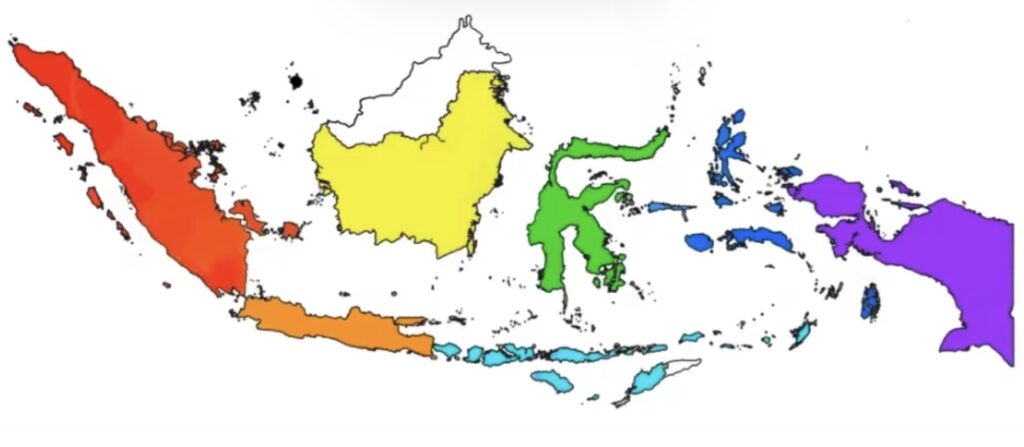 SUMATRA – KALIMANTAN – MALUKU – SULAWESI – PAPUA – JAVA
We’d like to thank all participants for their contributions to the event – in particular the representatives of the universities, Dalang’s authors and translators, and Martin Nuh Hanan for editing our videos.
The aftermath of World War II and the turmoil of the Indonesian Independence changed Lian Gouw’s way of life. After living in a foreign country and speaking a foreign language for nearly four decades, she finally had the opportunity to pursue an old dream: to become a writer. Unfortunately, she also realized that she had lost the ability to write in Dutch. Gouw then decided to study creative writing and returned to college. After completing four edits over seven years, in June 2009, Only a Girl was published by Publish America. In April 2010, the Indonesian translation and publishing rights for Only a Girl were purchased by PT Gramedia Pustaka Utama.
When Gouw founded Dalang Publishing in 2012, she bought back the publishing rights for Only a Girl from Publish America. Since then, the novel has been published by Dalang Publishing and distributed by Ingram. It is available on amazon.com and some independent bookstores.
Widjati Hartiningtyas, who translated Only a Girl for P.T Kanisius in Yogyakarta, deserves special kudos for her hard work in finding the right words which resulted in Mengadang Pusaran. (PT Kanisus 2020).
Lian Gouw can be reached at: dalangpublishing@gmail.com
***
CHAPTER 9
Nanna covered the tender buds on the rosebushes with empty eggshells to protect them from insects and wished there were a way she could shield her family from harm just as easily. She knew the ancestors and gods would not be able to keep them safe until the war was over. Nanna had always considered war to be a man’s affair, but this war not only involved Carolien, it had also found its way to Jenny.
The voices of Chip, Ting, and Mundi came from the kitchen area, interspersed with hammering and sawing. Chip had decided that he would use the kitchen cupboard as his hiding place should the Japanese come looking for him, and the dogs would serve as protection. Nanna had not asked for details. She was fully aware of the tension that hung in the air. It made the women nervous and irritable and the men more silent than usual. Nanna spent a lot of time on the front porch bench, looking down the street. When Jenny joined her she silently rubbed the girl’s hand, her heart filled with a mother’s fear for the safety of her children.
Almost a week went by before a Japanese jeep stopped in front of the house one afternoon. Four Japanese soldiers jumped out and walked up the driveway with their rifles slung loosely across their shoulders. Nanna grabbed Jenny’s arm and drew her close.
The Japanese halted for a moment in the driveway before the sergeant walked with confident strides up the porch steps. He bowed to Nanna and flashed a big smile to Jenny. He then took a letter out of his shirt pocket and handed Nanna the document.
She shook her head. “I can’t read.”
“Who else is home?” The Japanese spoke in heavy accented Malay.
“My daughters and granddaughters.”
One of the soldiers offered Jenny a piece of melted chocolate. When she shook her head and scooted closer to Nanna, he shrugged his shoulders.
“Do you know Ong Chip Hong?” the sergeant asked.
“Yes, he’s my son.”
“Where’s he now?”
“Not home.”
“When will he be home?”
“I don’t know.”
“Who’s the head of the household?”
“I’m a widow. He’s the oldest son living with me, so he is.” Nanna held the Japanese in a steadfast gaze. “Who’s the letter for?”
“The head of the household.” The soldier replied, puzzled.
“Then I guess you have to come back when he is home.”
The soldier who had offered Jenny the chocolate held his arms out for her. “Come.” His broad smile showed a gold tooth. “At home I have a little girl, just like her.” The soldier patted Jenny on the head, then abruptly turned around and joined the others walking down the driveway.
Nanna waited for the sound of the jeep to disappear into the empty street before taking Jenny inside the house. She knew it was only a matter of time before the Japanese would be back. Her children’s Dutch involvement drew them, and it would not be possible to hold them off forever.
Two days later, Nanna and Jenny were dusting the altar tables while Carolien worked on a sewing pattern at the dining room table, when the dogs barged into the room barking furiously. Someone was at the gate.
Nanna put her dust rag down. “Lock up the dogs,” she said, “and tell Chip and Ting the Japs are here.” Nanna threw a quick glance at her late husband’s portrait on the altar wall.
The same four Japanese soldiers who had come two days before stood on the porch. The one closest to the door asked, “Is Ong Chip Hong home?”
“No.” Nanna put an arm around Jenny.
“We need to search the house,” the soldier said.
Nanna pulled her shoulders back and looked at each soldier with a steady gaze. “I won’t let you in,” she said firmly.
Some of the soldiers shifted the guns slung across their shoulders.
The dogs’ barking became faint. Nanna knew they would be locked up in the kitchen by now. She took a few deep breaths.
Ting opened the front door and spoke into her back. “Mother, please, let me help these gentlemen.”
Nanna did not move. She had always given Ting the same preferential treatment reserved for Chip, even though he was only a second son, but now he was asking her to take direction from him. Was this the day that her vision would come true?
Nanna put a hand on Jenny’s shoulder. She steered the girl past the soldiers. “Jenny, come,” she said, “sit by me.”
Jenny obeyed quietly.
The men entered the house as Nanna and Jenny took their seats on the porch. The dogs barked ferociously at the intruders, until a rapid rattling of gunshots rang out, followed by screams from Sue, Emma, and Els, mixed with agitated Japanese voices. Nanna felt her chest expand. She clamped one hand around the edge of her seat and grabbed Jenny’s arm with the other. The dogs were quiet now. Nanna took a deep breath. Something hard and large dislodged itself inside her as she tried to breathe and stay calm. Had the time of mourning come already?
Els came running through the front door. “Nanna! Nanna! They shot the dogs! The Japs are going to kill us all!”
Jenny jumped up. “Is Claus dead? Did the Japs kill Claus?”
“Jenny, stay here!” Nanna pulled Jenny back into her seat. Making room for Els on the bench, Nanna reached for the sobbing girl.
Voices came closer. The Japanese soldiers came through the front door. Nanna spotted Chip in their midst. She saw Ting, Eddie, Sue, Carolien, and Emma following them and she breathed easier. It seemed the dogs had been the only victims of the gunshots.
Nanna stiffened when the men walked by. She closed a hand around Els’ shoulder. Pulling Jenny closer, she cast a glance at Chip. He looked away but she caught a glimpse of his battered face and noticed the bright red spots on the handkerchief he held pressed against his mouth.
Nanna watched Chip climb into the Japanese jeep. He moved slowly, burdened by Dutch secrets. Nanna knew her son would not talk. His blood would be thick and silent.
***
Carolien sat on the floor of Ting’s room with Claus’ head in her lap. Ting, sitting next to her, wrapped one of the dog’s front paws in a towel. Claus whimpered and she stroked the dog between his ears.
One of his pads is cut wide open.” Ting looked up, his face ashen. “He might have stepped on broken glass.”
“What are you going to do?” Carolien was irritated. She had never understood Ting’s devotion for his dogs. She wanted to tell him to be happy the Japs had only shot the dogs, it could have been any of them, but she knew better.
“I’ve got to find the shard and take it out. Here, hold the towel against the wound. Try to stem the blood flow.” Ting rose. “I’ve got to get a few things.”
Once alone in the room, Carolien straightened. Her back hurt from sitting bent over for so long. A heap of bloody towels reminded her of the afternoon. The Japs storming into the house, waving their guns, screaming, “Ong Chip Hong! Come out!” The dogs barking and jumping against the closed kitchen door, the sudden gunfire, the dogs dropping to the floor, her standing there with shaking knees, afraid the bullets would hit the cupboard, penetrate the wood, and hit Chip. What would the Japs do to Chip? Although she was aloof with her brothers, she looked up at Chip and admired him greatly.
Ting returned, followed by Eddie and Jenny.
“Claus!” Jenny cried, dropping next to the dog. He lifted his head, whimpering.
“Here, if you hold his head in your lap, I can help Youngest Uncle check his leg.” Carolien shifted the dog’s head carefully into Jenny’s lap.
“Oh, Claus. You’ll be okay.” Jenny scratched the dog’s ears. Stroking his muzzle, she repeated, “You’ll be okay. You’ll see.” Claus sighed and slapped the floor with his tail.
Jenny watched as Ting washed the dog’s paw in a solution of water and iodine before pulling out the shard with a pair of tweezers. “I want to be a veterinarian when I grow up,” she said.
Ting laughed and Eddie said, “I think you’ll be a good one.”
Carolien frowned. Jenny was picking up too much of Nanna’s and Ting’s ways. With all the decent occupations to choose from, why did she want to become a veterinarian?
Eddie helped Ting and Carolien pick up the room before taking a seat on the edge of Ting’s bed.
“Where are all the other dogs?” Jenny stroked Claus between his ears.
“Dead.” Eddie clenched his jaws.
“Caesar too?”
“No. He almost killed one of the Japs. You should’ve seen how that dog attacked.” Eddie rose. “Fortunately, the Japs didn’t shoot him, they only clubbed him. Youngest Uncle was able to get him away in the midst of the commotion and put him with Emma in the servant’s bathroom. He might have gotten away with a broken shoulder.”
“Why did the Japs take Oldest Uncle with them and why did they kill all the dogs?” Jenny asked, keeping her eyes on Claus.
“Before the war, Oldest Uncle worked for the Dutch government. As a matter of fact, he still does.” Eddie stopped abruptly when Carolien glared at him.
“And?”
“The Japs wanted Oldest Uncle to tell them about his office. He hid in the big kitchen cupboard, we thought he would be safe there. No one expected the Japs to gun down the dogs.”
“Are the Japs going to kill Oldest Uncle?”
“Let’s hope not,” Carolien said. “The Dutch will be back soon and I’m sure they’ll set Oldest Uncle free.” She tried to sound convincing, but she knew that no one, including herself, believed her.
***
Chip’s capture by the Japanese moved slowly into the background of everyday life. Across the country families bound together to get through the war. With the Dutch government shut down and no salary coming in, Ting and Carolien began trading on the black market. The tobacco store that Chip and Ting had set up as a front for their undercover work now also carried clothing and foodstuffs. Carolien took in sewing. Along with Eddie and Ting, she was active in the Dutch Underground.
With the Dutch schools shut down Els took responsibility for Jenny’s schooling, tutoring her every day so she wouldn’t fall behind. Els had received her teaching credential just before the war broke out but had not worked in a school yet. The family disapproved of her teaching at a school for natives and there had been no openings yet at any of the Dutch schools.
By September, the mango blossoms had turned into plump, deep-yellow fruit but the war showed no signs of ending soon. Jenny was in the backyard, helping Nanna and Mundi prop up the laden mango branches, when a car stopped by the front gate and the bell rang. She ran to see who it was, but Nanna called her back and sent Mundi instead.
Jenny shot Nanna a sideways glance. The dogs lay near her, their ears perked, noses pointed toward the gate. An eerie stillness filled the moments before Mundi returned with a letter in his hand. He fell to his knees and bowed deeply before handing Nanna the brown envelope.
Nanna straightened herself. “Thank you,” she said. Her voice was steady but her hand trembled as she took the item. “You and Non Jenny finish up while I take this inside.”
Mundi remained on his knees as Nanna walked away. “It’s all because of the Dutch, Nonnie.” Mundi sighed, rising when Nanna was out of sight.
“Why do you say that?” Jenny frowned. She wasn’t used to servants talking without being spoken to first.
Mundi reached for the bamboo pole Nanna had left leaning against the tree trunk. “It’s time for the Dutch to go back to their country, Young Miss,” Mundi said and walked away.
Jenny watched Mundi disappear into the garden. Was Mundi against the Dutch? Did he side with the Japs? Maybe Mundi was traitor….
After dinner that night Nanna took a letter from the altar table and handed it to Ting. “The Japs delivered this earlier,” she said.
Ting used his fruit knife to open the envelope. Jenny saw him blinking hard as he glanced at the page. He cleared his throat before reading aloud to the gathered family. “The Japanese Emperor and government regret that prisoner Ong Chip Hong’s uncooperative attitude necessitated the use of more forceful methods than are customary. We further regret to have to inform you that during the course of interrogation, the above mentioned prisoner died on September 27, 1944. The Japanese authorities have disposed of his body.” Ting’s voice faltered.
Sue burst into tears. Els got up and walked to Nanna. Eddie pulled Jenny on his lap so Els could sit in the chair next to their grandmother. Carolien and Emma cried into their napkins.
Nanna walked to the altar. She lit a bundle of incense sticks and raised them high in prayer. “The Dutch are asking too much,” she said without turning around.
Jenny stared at her grandmother’s rigid back and chewed her knuckles. She noticed a new urn on the altar table. When did Nanna place it there? Was Nanna now asking the spirits why Oldest Uncle had to die? What would their answer be?
*****
.
Widjati Hartiningtyas has a strong interest in languages. The first foreign language she mastered was English. Her love for books and languages led her to choose a language major at high school and an English Literature discipline at the Semarang State University (UNNES). After graduating from UNNES in 2004 with a BA of Letters degree, Tyas worked as a teacher.
Besides working as a freelance translator, she started writing stories for children. Some of her published works are activity books. Ready to go to Elementary School with Piko (PT Tiga Serangkai, 2018) and Rori’s Exciting Adventures series (PT Kanisius, 2017).
Widjati Hartiningtyas can be reached at: widjati@gmail.com
***
Bab 9
Nanna menutupi kuncup-kuncup lembut bunga mawar dengan cangkang telur kosong untuk melindunginya dari serangga. Dia berharap semudah itulah cara melindungi keluarganya dari bahaya. Dalam hati kecilnya dia tahu bahwa para dewa dan leluhurnya tidak akan bisa melindungi mereka hingga perang berakhir. Nanna selalu berpikir bahwa perang adalah urusan lelaki. Namun, perang ini tidak hanya melibatkan Chip dan Ting. Perang ini juga telah melibatkan Jenny.
Suara Chip, Ting, dan Mundi di dapur ditingkahi bunyi orang memalu dan memotong kayu. Chip telah memutuskan untuk bersembunyi di lemari dapur jika orang Jepang mencarinya. Anjing-anjing peliharaan mereka akan bertugas untuk melindunginya.
Nanna tidak meminta penjelasan secara terperinci. Dia bisa merasakan ketegangan yang ada saat ini. Para perempuan menjadi gugup dan mudah jengkel, sementara para laki-laki menjadi lebih pendiam dari biasanya. Nanna banyak menghabiskan waktu duduk-duduk di beranda depan dan mengawasi jalanan. Ketika Jenny mendatanginya dan dengan manja menggelendotinya, Nanna hanya mengelus-elus tangan gadis itu tanpa mengatakan apa-apa. Hatinya dipenuhi kekhawatiran seorang ibu akan keselamatan anak dan cucunya.
Suatu siang, hampir seminggu kemudian, sebuah jip Jepang berhenti di depan rumah Nanna. Empat serdadu Jepang turun dari mobil lalu menyusuri jalan masuk dengan senapan melintang di bahu. Nanna meraih lengan Jenny dan menariknya mendekat.
Serdadu Jepang itu berhenti sesaat di jalan masuk sebelum sang sersan menapaki tangga beranda dengan langkah tegap. Dia membungkukkan badan di depan Nanna lalu menyunggingkan senyum lebar kepada Jenny. Sersan itu mengambil selembar surat dari saku kemejanya kemudian memberikannya kepada Nanna.
Nanna menggelengkan kepala. “Saya tidak bisa membaca.”
“Siapa lagi yang ada di rumah?” Sersan itu berbicara dengan bahasa Maleis berlogat asing.
“Anak perempuan dan cucu perempuan saya.”
*****
Untuk membaca cerita ini secara lengkap silakan membeli bukunya melalui https://toko.kanisiusmedia.co.id/product/mengadang-pusaran/
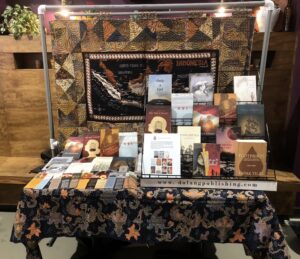
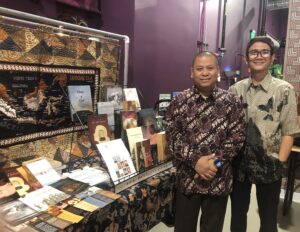
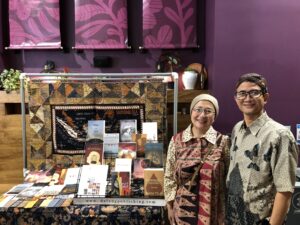
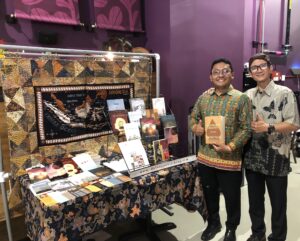
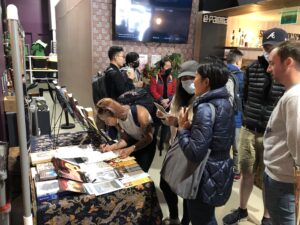
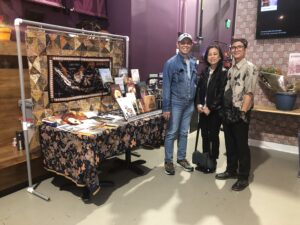
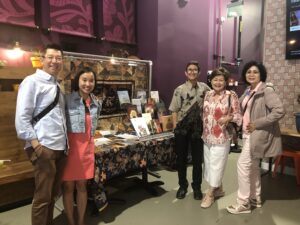
A generous invitation from the Indonesian Consulate in San Francisco enabled Dalang Publishing to participate in the 2nd Annual Indonesian Bazaar held by Friends of Indonesia on May 20, 2023, in the La Cocina Municipal Marketplace, San Francisco. The event showcased Indonesian handcrafts, dance, and food.
We proudly presented our 12 titles, including our 10th anniversary publication, Footprints / Tapak Tilas, a bilingual short-story compilation that takes readers on a historical and cultural journey across Indonesia. Footprints / Tapak Tilas offers 49 short stories, comprising the work of 44 authors and 18 translators all previously published on Dalang’s website.
We were honored by a visit from Bapak Prasetyo Hadi, the Consul General of Indonesia for San Francisco, and his wife, Ibu Ota, as well as Bapak Mahmudin Nur Al-Gozaly, Consul for Information, Art and Culture. Our booth attracted many visitors, and we received several book orders.
Maria Matildis Banda finished her graduate studies at Universitas Udayana (UNUD) in Denpasar, and now teaches at the Faculty of Cultural Studies of UNUD. She started writing short stories in 1981. Teaching and researching the oral traditions of Nusa Tenggara Timur (NTT), the southernmost province of Indonesia, has given her a strong basis for writing novels with an ethnic background. Between 2015 and 2021, she wrote and self-published three novels set in NTT: Wijaya Kusuma dari Kamar Nomor Tiga, about postnatal care in Flores; Suara Samudra, about whale hunting; and Bulan Patah, about childbirth outside of wedlock. A fourth novel, Doben (Lamalera 2017), is set in Timor Island. Maria has written the column “Parodi Situasi” in the Pos Kupang Daily since 2000.
Maria Matildis Banda: bmariamatildis@gmail.com
Nyale
Cuplikan dari novel Pasola yang akan segera terbit
Malam gelap gulita. Ini malam ketujuh menurut perhitungan rato nyale, tetua adat, yang telah memperhitungkan perjalanan bulan gelap pada bulan Maret tahun 1934 itu untuk kedatangan cacing laut, di Pantai Ratenggaro. Sore hari, semua anggota keluarga membersihkan makam leluhur dan keluarga di depan Kampung Ratenggaro dan sekitarnya. Pada malam hari, perempuan dan laki-laki menari dan kawoking di pelataran.
Setelah Waleka mengikuti Limbu Koni dan Biri pulang ke rumah, masih ada banyak orang yang menari sampai jauh malam demi menunggu waktu kedatangan nyale. Pada jam empat pagi, hampir semua orang meninggalkan rumah menuju pantai yang masih gelap.
Waleka berjalan di depan diikuti Inya Peke. Di belakang Inya Peke, ada Limbu Koni yang menggandeng lengan Banu, anak Inya Peke. Mereka diikuti Biri, teman akrab Limbu Koni, kedua orang tua Waleka, serta anggota keluarga lainnya.
“Kenapa nyale datang waktu bulan gelap?” Banu bertanya. “Nyale takut bulan, takut matahari!” Limbu Koni yang menjawab. “Semoga nyale gemuk-gemuk dan ada semua warna,” katanya lagi.
“Nale atau nyale, Inya?” Banu bertanya lagi.
“Nale atau nyale sama saja, sama-sama cacing laut. Yang pasti, cacing laut yang datang hari ini banyak sekali,” sambung Biri.
Angin berembus perlahan membelai wajah-wajah yang diliputi harapan. Mereka berjalan beriringan menuju Pantai Ratenggaro yang jaraknya hanya selemparan batu dari uma parona.
“Engko cocok tinggal di sini. Dekat pantai. Sudah tiga hari di sini engko tidak pernah mengeluh sesak napas,” kata Limbu Koni yang dijawab Biri dengan lantunan memanggil nyale yang sudah didengarnya sejak sore kemarin.
“Laki-laki yang menarik tanganmu itu … Ndalo namanya? Tidak tahu malu!” Biri berbisik.
“Jangan pedulikan. Biarkan saja. Diam,” kata Limbu Koni.
“Kita pesta hari ini!” kata Inya Peke. “Pesta nyale dan pesta pasola. Waleka pasti gagah sekali hari ini.”
“Saya mau jadi to paholong seperti Bapa Waleka,” Banu berceloteh sambil menarik tangan ibunya.
“Bagus sekali. Bapa Waleka adalah to paholong yang duduk di atas pelana. Gagah perkasa seperti siapa?” tanya Limbu Koni.
“Banu!” jawab Banu sambil tertawa.
Dengan gembira mereka berjalan melalui binya bokolo, pintu gerbang utama di antara makam batu, memasuki jalan setapak menuju pantai. Debur ombak terdengar jelas menandakan bahwa pantai berada sangat dekat. Bulan tidak ada. Kerlap-kerlip bintang, harapan, dan kebutuhan adalah petunjuk jalan menuju pantai. Semuanya ingin menemukan nyale di Pantai Ratenggaro.
Waleka melantunkan kawoking,
Nyale ayam wo wo wu
Ibunda nyale bunda nyale bertelur banyak-banyak
Sebanyak-banyaknya seperti telur siput
Sebanyak-banyaknya seperti telur belalang
Potong-potong gumpalan telur yang banyak
Nyale ayam wo wo wu
Ibunda nyale bunda nyale
Banyak seperti telur siput … wo wo wu
Syair dilantunkan bergantian sejak berjalan dari kampung dengan harapan cacing laut datang dalam jumlah banyak seperti telur siput dan telur belalang. Semua orang masuk ke laut yang sudah surut. Dinginnya air laut di keremangan pagi menyengat kulit kaki yang telanjang. Telapak menyentuh pasir dan batu- batu kecil di dasar laut yang terasa licin. Sementara tangan meraba-raba menyentuh cacing yang licin dan geli. “Oh dapat, licin, banyak, geli, wo wo wu … wo wo wuuu,” ramai suara-suara dengan berbagai ucapan sambung-menyambung.
Bau Nyale adalah kebiasaan menangkap cacing nyale. Bau cacing-cacing laut yang ditangkap itu dapat dicium warga yang ada di pantai.
Waleka bergerak kian kemari menjemput nyale dengan penuh semangat. Dia menyentuh dan menggenggam erat cacing-cacing yang didapatnya dari balik batu-batu kecil.
Inya Peke mengikutinya sambil menadah dengan sebuah keranjang. Banu, Limbu Koni, dan Biri juga berada di sekitarnya. Biri selalu meloncat-loncat karena geli, tapi tetap berupaya untuk memasukkan tangannya ke dalam air, merogoh di balik batu untuk menangkap cacing yang bergerak-gerak dan licin.
Limbu Koni berada dekat Waleka. Dia menahan rasa geli saat cacing-cacing itu menyentuh kakinya berkali-kali. Dia menunduk sambil meraba-raba di balik batu. Demikian juga Waleka. Keduanya tertawa saat tangan mereka saling bertemu. Keduanya menangkap cacing-cacing itu di balik batu yang licin. Mereka bangga bukan main saat berhasil menambah jumlah nyale dalam wadah yang dibawa Banu dan Inya Peke.
“Bola nyale!” tiba-tiba Waleka berseru saat kedua tangannya menjemput sarang nyale. Gumpalan cacing itu membentuk bola besar, sedikit lebih besar dari bola kaki. Dia segera keluar dari air menuju tepi pantai diikuti Limbu Koni, Biri, Banu, Bapa, Inya, kakak, serta keluarganya yang lain.
“Tangkap lagi, Bapa,” Banu girang bukan main. Dia memohon agar boleh menangkap lagi karena di tangannya hanya ada beberapa ekor cacing yang kemudian dimasukkan ke dalam wadah kecil yang tergantung di lehernya.
“Cukup,” jawab Waleka, “ini sudah banyak sekali. Bagi-bagi dengan orang lain,” bisiknya di telinga ponakannya.
Kegiatan menangkap cacing laut itu berhenti ketika ujung sinar matahari mulai muncul di cekungan tanjung kecil di bawah tebing Kampung Ratenggaro. Semua orang kembali ke pantai dengan hasil tangkapannya masing-masing. Dengan gembira, mereka pulang ke kampung. Sarang nyale hanya berhasil didapatkan Waleka.
Meskipun Limbu Koni tidak berkata apa pun padanya, Waleka tahu gadis itu bangga dan mengaguminya.
“Itu tanda engko ada untuk Waleka,” Inya Peke menggoda Limbu Koni. “Jodoh. Lancar semuanya.”
“Pesta tidak lama lagi,” sambung Biri.
“Sama dengan engko. Wuri Wona sudah tidak sabar menunggu,” keduanya tertawa.
Sarang nyale diurai di sisi mata api, bagian tengah rumah panggung yang digunakan sebagai dapur. Bola dibagi tiga dan berada dalam genggaman Limbu Koni, Inya Peke, dan Biri. Selanjutnya diurai. Beberapa kali gumpalan terjatuh karena licin dan cacing yang diurai dari gumpalan bergerak dan merayap gelisah kekurangan air.
Banu yang selalu memungut dan meletakkannya kembali ke dalam wadah. Sungguh sangat banyak cacing gemuk dan berwarna-warni cerah dan menggiurkan.
“Merah, hijau, kuning, putih, hitam, wuiih ada semua warna,” kata Banu dengan gembira. Kedua orang tua Waleka, para perempuan dan laki-laki serta segenap anggota keluarga, gembira. “Gemuk-gemuk! Warnanya terang. Tanda apa Inya?” tanya Banu.
“Tanda subur, panen limpah, hidup jadi lebih baik,” jawab Limbu Koni yang disambut dengan syukur oleh Biri dan Inya Peke. Aneka masakan dari bahan nyale mulai diolah. Limbu Koni dan Biri membantu Inya Peke dan keluarga besar Waleka dengan cekatan.
“Nyale palowor,” kata Inya Peke kepada Limbu Koni.
“Ya Inya,” jawab Limbu Koni sambil tertawa. Bersama Inya Peke dan Biri dia memasak nyale palowor. Masakan dengan bahan utama cacing nyale dan santan kental. Baunya harum dan rasanya lezat setelah dilengkapi dengan berbagai bumbu.
“Kita buat bodho juga kah, Inya?” tanya Biri.
“Ya, dendeng nyale itu disimpan di sini,” jawab ibu Waleka sambil menyerahkan sebuah periuk tanah. “Cukup untuk beberapa bulan ke depan! Wah, banyak sekali!” katanya dengan bangga.
Mereka juga membuat sambal dengan bahan dasar lombok hijau dan cacing yang gemuk-gemuk dan terang warnanya.
Limbu Koni dan Biri terlibat secara langsung dalam segenap kegiatan dapur.
Waleka bangga karenanya. Dia terutama bangga pada Limbu Koni.
Keduanya hanya berani curi-curi pandang dan segera menghindar setelah ketahuan satu sama lain. Akan tetapi, Waleka tahu bahwa nanti di lapangan pasola segalanya akan menjadi lebih indah, memesona.
Sarapan pagi dihidangkan sebelum berangkat ke lapangan pasola. Ayah Waleka bicara sebelum makan. Di hadapan sanak saudara yang datang dari jauh, lelaki tua itu menggarisbawahi beberapa hal. Bapa Tua menyampaikan hal itu dalam bahasa setempat.
“Waleka sudah tangkap sarang nyale pada Bau Nyale di pantai. Jaga itu rezeki untuk sepanjang hidup. Sarang nyale yang besar kumpulan nyale berwarna-warni, gemuk, dan bercahaya. Itu khusus, sangat khusus! Tidak semua pencari nyale mendapatnya. Ini tanda untuk rezeki seumur hidup. Hanya engko saja yang dapat sarang nyale. Itu sungguh luar biasa. Engko diberi banyak. Jaga itu. Kalau engko lupa bahwa engko sudah diberi begitu banyak dalam sarang nyale, apa pun akan diambil kembali dari engko.”
“Ya, Bapa,” jawab Waleka dengan yakin.
“Hidup harus setia dan jujur. Bersyukurlah pada apa yang engko punya. Jangan ambil lebih. Apa pun tantangannya, jangan pernah ambil lebih. Apalagi kalo engko ambil yang bukan engko punya,” kata bapanya lagi. Diikuti dengan berbagai pesan untuk anak cucu turun-temurun. Bapa Tua melengkapi pesan yang disampaikan pada acara duduk bersama di rumah panggung mereka.
“Engko akan jadi to paholong terbaik sepanjang hidup,” kata Bapa Tua lagi dan Waleka mendengar nasihat ayahnya dengan saksama.
“Ya Bapa!”
“Setia dan jujur itu kuncinya,” Bapa Tua tegas. “Tidak hanya pada gaya lompat dan kemampuanmu melayang bersama kudamu, Lenggu Lamura, pada titik lembing dilempar,” Bapa Tua berhenti sejenak sebelum bicara lebih lanjut, “tapi juga setia dan jujur pada kuda yang terbang bersama engko. Di lapangan pasola, engko dan Lamura adalah satu,” Bapa Tua menatap Waleka dengan tajam sambil menggarisbawahi, “Lamura dan engko adalah satu. Ingat itu.”
“Ya Bapa!” Waleka menyetujui dengan sepenuh hati.
“Tidak hanya pada kemenangan dan kepuasan mengenai dan menjatuhkan sasaran, tetapi juga pada kerendahan hatimu merangkul dan menolong kembali lawan yang engko kalahkan.” Bapa Tua berbicara kata demi kata dan diperhatikan dengan saksama oleh semua yang hadir, termasuk Limbu Koni.
Calon istri Waleka itu memperhatikan wajah calon mertuanya. Sorot matanya teduh, alis matanya tebal. Tulang pipinya menonjol dan rahangnya tampak kukuh. Wajah Waleka mirip sekali dengan ayahnya.
“Engko harus yakin bahwa setiap tetes keringat dan setiap tetes darah yang jatuh di lapangan itu jatuh dengan jujur dan setia dan tidak akan jadi kering di sana. Tidak hanya untuk panen hasil kebun, tetapi lebih dari itu, demi kehidupan yang sesungguhnya. Setia dan jujur itu kuncinya!”
Limbu Koni terpana oleh kata-kata Bapa Tua. Dia benar-benar seorang kabani pa ate — julukan yang diberikan kepada laki-laki yang pandai dan cerdas.
Pengalaman hidup dan perantauannya membawa ternak sampai ke Flores, Timor, Alor, bahkan sampai di Maluku dan Sulawesi pada masa muda dulu, membuat Bapa Tua itu matang pada hari tua, di hadapan anak-anak, cucu, dan keluarga besarnya. Apalagi di hadapan Waleka, satu-satunya anak laki-laki dalam keluarga.
“Bapa Tua itu kabani pa ate yang luar biasa,” bisik Biri.
“Ya,” jawab Limbu Koni. “Semoga Waleka bisa menjaga kata-kata Bapa Tua sepanjang hidupnya,” kata Biri. “Semoga.”
“Ya,” jawab Limbu Koni. Dirinya merasa kata-kata itu tidak hanya ditujukan bagi Waleka sebagai to paholong, tetapi juga bagi dirinya yang sudah diterima sebagai bagian dari uma parona keluarga besar Waleka.
Waleka pun merasakan hal sama. Dia tahu, sebagai laki-laki Ratenggaro, dia harus menjadi laki-laki yang setia dan jujur. Tergetar hatinya ketika menyadari Bapa Tua sedang menatapnya lekat-lekat.
“Kalau engko jujur dan setia, engko pasti bisa jaga harga diri keluarga, uma parona, Ratenggaro, kabisu, suku, dan tentu saja harga dirimu sendiri,” Bapa Tua tersenyum setelah selesai bicara. Sorot matanya memberi sinar dan harapan bagi Waleka.
Diam tetapi pasti, Koni juga mencatat setiap kata Bapa Tua ke dalam pikiran dan hatinya. Dia angkat wajahnya sejenak memperhatikan wajah laki-laki tua itu lagi. Koni terkenang Bapa Bili, guru di Weetebula, yang selalu bicara dengan tenang setiap kali memberi nasihat. Saat Koni berpindah tatapannya ke wajah Mama Tua, ibu Waleka melempar senyum yang ikhlas.
*****
Since 2005, Yuni Utami Asih has taught the English Education Study Program (FKIP) at her alma mater, Mulawarman University. During her childhood, her father borrowed books for her from the mobile library. In high school, she fell in love with Ermah’s Indonesian translation of The Count of Monte Cristo (Dunia Pustaka Jaya, 1992). She continued her master’s and doctoral studies at the State University of Surabaya. In 2011, she was funded by the Indonesian Ministry of Education and Culture to visit Leiden University in The Netherlands. She stayed for two months to deepen her research for her final doctoral project, the phonology of the Kenyah language.
In addition to teaching, Asih has also been a guest speaker in several English language courses.
Yuni Utami Asih: kelasyuni@gmail.com
Nyale
An excerpt from Pasola, an upcoming novel
The night was pitch dark. An elder who had calculated the moon journey declared that the nyale, sea worms, were to appear at the Ratenggaro Beach on the seventh night of March 1934. Earlier that afternoon, every family in the Ratenggaro village on Sumba Island, cleaned the ancestral graves and their surroundings. Through the evening, women and men danced and chanted on the village square while waiting for the arrival of the nyale.
After Waleka followed Limbu Koni and Biri home, many people continued to party. Around four in the morning, most of the villagers headed to the dark beach. Bau Nyale was the traditional annual ritual of catching sea worms.
On their way to the beach, Waleka was followed by his sister, Inya Peke. Limbu Koni held Banu, Inya Peke’s son, by the arm as they walked behind them. They were followed by Limbu Koni’s best friend Biri, Waleka’s parents, and other family members.
“Why do nyale come when the moon is dark?” asked Banu.
“The nyale are afraid of the moon and sun!” Limbu Koni replied. “Hopefully there will be a lot of fat, colorful nyale.”
“Nale or nyale, Inya?” Banu asked.
“Nale and nyale mean the same,” Biri replied. “The word refers to a sea worm. I believe that there will be an abundance of sea worms this time.”
The wind gently caressed their hopeful faces as they walked to the Ratenggaro Beach, close to their uma parona, family home. “You should be living here, near a beach,” said Limbu Koni to Biri. “During the three days you’ve been here visiting, you’ve not complained of being short of breath.”
Biri replied by chanting the mantra call for the nyale, then whispered, “The man who pulled your hand — is his name Ndalo? Such a shameless man!”
“Don’t worry about him,” Limbu Koni replied. “Just leave it alone.”
“We’re going to have a party today!” shouted Inya Peke. “We’ll celebrate the nyale catch and the sacred Sumbanese pasola. Waleka will be dashingly handsome at the annual equestrian spear-fighting competition!
“I want to be a to paholong like Bapa Waleka,” Banu said, pulling his mother’s hand.
“That’s good!” Inya Peke replied. “You can be like your Uncle Waleka, a spear fighter who sits high in his saddle. He’s as handsome as …”
“Banu!” Banu replied laughing.
They walked happily through the binya bakolo, the main gate between gravestones, and entered the footpath to the beach. The sound of rolling waves indicated that they were almost there. Starlight, hope, and need led the eager villagers to the Ratenggaro Beach in search of nyale.
Waleka chanted a kawoking, the mantra to call the nyale.
Nyale ayam wo wo wu
The mother of nyale, Mother Nyale
Spawn abundantly
Lay as many eggs as a snail
As many as a grasshopper
Cut up the many egg clusters
Nyale ayam wo wo wu, chicken nyale wo wo wu
The mother of nyale, Mother Nyale
Lay as many eggs as a snail.
The people took turns chanting the mantra as they walked. They hoped the sea worms had been as prolific as grasshoppers and snails. Everyone waded into the receding sea. The chilly water stung their bare legs. Their feet moved across the slippery pebbles while they groped for sea worms. Voices called out in turns: “I caught some!” “They are slippery!” “Wow! There are a lot!” “It tickles!” “Wo wo wu, wo wo wuuu!”
The smell of the sea worm catch filled the air.
Waleka jumped around. Fingering rocks and bed gravel for the sea worms, he held on tightly to the worms he caught.
Inya Peke and Banu followed him, carrying baskets. Limbu Koni, and Biri were nearby. Biri, experiencing her first Bau Nyale, kept dipping her hands in the water, trying to catch the evasive, slippery worms.
Limbu Koni steeled herself when the worms touched her feet. She looked down while fingering a rock. So did Waleka. Both laughed when their hands touched as they caught the worms around the rocks. They proudly added their catch to the growing number of nyale in the baskets Banu and Inya Peke carried.
“A nyale ball!” Waleka shouted as he yanked up a nyale nest. The clump of worms formed a large squirming ball, slightly larger than a soccer ball. He immediately returned to the beach with everyone on his heels.
“Let’s find some more!” Banu shouted excitedly. He wanted to catch more worms because he only had a few in the small basket hanging from his neck.
“We have enough,” Waleka whispered to his nephew. “This is already a lot. We must share with other people.”
The Bau Nyale came to an end as the sun reached the hollow of the small headland below the cliffs of Ratenggaro. Everyone left the shore with their catch and walked cheerfully to the village. Waleka was the only one who had caught a nyale nest.
Though Limbu Koni had not said anything to him, Waleka knew she was proud of him and admired him.
“That is the sign that you are here for Waleka,” Inya Peke teased Limbu Koni. “You are meant for each other. Everything is going smoothly.”
“We will soon have a celebration!” Biri added.
“Just like you. Your fiancé, Wuri Wona, can’t wait.” Limbu Koni and Biri burst out laughing.
Back in the village, the nyale nest was unraveled beside the wood stove, in the center of the stilt house used as a kitchen. The ball was divided into thirds. Limbu Koni, Inya Peke and Biri each took a third. The slippery masses fell several times. The worms, loosened from the ball, writhed and crawled, searching for sea water. Banu always picked them up and put them back into the basket. There were so many fat, bright, colorful, and tantalizing worms!
“Red, green, yellow, white, black — wow, we have every color!” Banu shouted happily. Waleka’s parents and all the other villagers were happy too. “The worms are fat!” Banu shouted again. “They are bright! What does it mean, Mother?”
“It’s a sign of fertile land, abundant harvests, and a better life,” Inya Peke replied. Biri and Limbu Koni agreed, as they skillfully helped Inya Peke and Waleka’s extended family prepare a variety of nyale dishes.
Together with Inya Peke and Biri, Limbu Koni started to prepare nyale palowor, a stew of nyale and thick coconut milk, complemented with various spices. It smelled fragrant and tasted delicious.
They also made a peppery sauce with green chilies and fat, bright, colorful worms. “Are we going to make bodho, too, Inya?” Biri asked.
“Yes, store the nyale jerky here,” Waleka’s mother answered, handing over an earthen pot.
“Wow, we have plenty!” she exclaimed proudly. “This will be enough for several months!”
Waleka was pleased to see Limbu Koni and Biri help with all the kitchen activities. He was especially taken with Limbu Koni. Waleka and Limbu Koni stole furtive glances at each other and immediately looked away after being caught by the other. But Waleka knew that later, on the pasola field, everything would change. Everything would become more beautiful, more intimate.
Finally, breakfast was served. Before everyone started to eat, Waleka’s father, Bapa Tua, gave a speech in the Sumbanese dialect.
In front of the villagers and relatives who had come from afar, the old man underlined several things to the gathering in their stilt house.
“Waleka, you caught a nyale nest during the Bau Nyale on the beach,” he said. “Take care of that fortune throughout life. To find a big nyale nest with colorful, fat, and luminous worms is special, very special indeed! Not all nyale seekers find one. This is a sign of a lifetime fortune. You’re the only one who caught a nyale nest. That is incredible. You’ve been given a lot. Take good care of the gift. If you ever fail to appreciate how much you’ve been given in the form of a nyale nest, you will lose everything.”
“Yes, Father,” Waleka answered confidently.
“Live a life that’s faithful and honest,” his father continued. “Be grateful for everything you have. Don’t take more than you need. Whatever the challenge might be, never take more — let alone things that don’t belong to you.” Bapa Tua continued his speech with life’s wisdoms that had been passed down for generations.
“You will be the best to paholong throughout your life,” Bapa Tua said, and Waleka listened carefully to his father. “Faithfulness and honesty are the keys,” Bapa Tua emphasized. “Not only in the jumping style and your ability to merge with your horse, Lenggu Lamura, when the javelin is thrown, but you also need to be faithful and honest to the horse you are riding. On the pasola field, you and Lamura are one.” Bapa Tua threw Waleka a sharp look before repeating, “You and Lamura are one. Remember that.”
“Yes, Bapa!” Waleka agreed wholeheartedly.
“Keep faithfulness and honesty not only in the victory and satisfaction of defeating an opponent, but also in your humanity in embracing and helping your defeated opponent.” Bapa Tua spoke each word carefully. Everyone present listened attentively, including Limbu Koni.
Waleka’s bride-to-be studied the face of her future father-in-law: calm eyes beneath thick eyebrows, high cheekbones, and a strong jaw. Waleka looked very much like his father.
“You must believe that every drop of sweat and every drop of blood that falls on the field falls honestly and faithfully and will not dry up there. Not just for the harvest, but more than that, for real life. Loyalty and honesty are the keys!”
Limbu Koni was moved by Bapa Tua’s words. He was a true kabani pa ate, a very clever and wise man. In his youth, Bapa Tua had traveled to Flores, Timor, Alor, even as far as Maluku dan Sulawesi to trade livestock. His children, grandchildren, and extended family believed that Bapa Tua’s experience made him wise in his old age. Especially for Waleka, the only son in the family.
“Bapa Tua is an extraordinary kabani pa ate,” Biri whispered to Limbu Koni. “Hopefully, Waleka can live up to Bapa Tua’s words for as long as he lives. Hopefully.”
“Yes,” Limbu Koni replied. She felt that Bapa Tua’s words were not only directed at Waleka as a to paholong, but also at her for being accepted as a part of Waleka’s extended family.
Waleka felt the same. He realized, as a Ratenggaro man, that he must be a faithful and honest man. His heart fluttered when he saw Bapa Tua looking at him intently.
“If you are faithful and honest, you will be able to take care of family pride, uma parona, Ratenggaro, kabisu, tribe, and yourself for sure.” Bapa Tua smiled. The look in his eyes gave Waleka light and hope.
Silently, Limbu Koni recorded all Bapa Tua’s words in her mind and heart. She lifted her head for a moment to watch the old man’s face again. Then Limbu Koni shifted her gaze to Mama Tua. Waleka’s mother threw her a warm smile.
“Do you understand, Waleka?” Bapa Tua asked.
“Yes, Bapa.” Waleka answered confidently.
*****
.
Benny Arnas‘s short stories have been published in many national newspapers such as Kompas, Koran Tempo, and Horison magazine. He won a number of writing contests. His novel, Kayu Lapuk Membuat Kapal (Diva Press, 2021) won first place in a Novel Writing Contest on Prophet Muhammad in 2021. His other novel, Curriculum Vitae (Gramedia Pustaka Utama, 2017) won the Jakarta Arts Council Novel Writing Contest in 2016.
Since 2009, Arnas has served the Benny Institute, a cultural association in his hometown, by organizing writing classes, acting classes, English classes, ulu literacy classes, book fairs, film festivals, book clubs, etc.
Benny Arnas Instagram: bennyarnas
Yun Labu dan Sayak-betingkat
Di bantaran anak Sungai Musi yang rindang, konon di kawasan yang sekarang dikenal sebagai Musi Rawas Raya, terdapat dua kerajaan. Pagarbesi, kerajaan dengan bala tentara dan abdi yang banyak di bagian selatan dan Batangpuan, yang jauh lebih kecil, di utaranya. Para perempuan, dari dua kerajaan yang suaminya pulang tiga bulan sekali sebab bertugas di Kerajaan Pagarbesi, berkeyakinan bahwa wujud cinta yang berbalas adalah bila sayak-betingkat, wadah makanan dari batok kelapa yang ditumpuk, kembali dalam keadaan kosong. Tidak terkecuali bagi Yun Labu. Putri Kerajaan Batangpuan itu melepas kebangsawanannya setelah dikawini Napalong, pengembara tampan yang berasal dari Kerajaan Pagarbesi.
Pertautan itu tidak mendapat restu Ginde Ulak dan Putri Mayang, orangtuanya yang tidak lain adalah pemuncak Kerajaan Batangpuan. Selain harkat yang tidak sejenjang, cara Napalong mengawini Yun Labu juga membuat mereka merasa diremehkan.
Napalong menculik Yun Labu ⸺ meskipun Yun Labu mengatakan kalau dialah yang minta diculik ⸺ dan membawanya ke kepala puak di kampungnya untuk dikawinkan. Hampir saja, Napalong dibunuh oleh para prajurit Kerajaan Batangpuan, bila Yun Labu tidak mengancam akan terjun ke jurang berbatu di perbatasan Kerajaan Batangpuan.
“Aku tak sudi pengembara itu menjadi bagian dari kerajaan ini,” desis Ginde Ulak dengan gigi bergemeretakan.
“Pun aku.” Putri Mayang tidak mau kalah. “Kabar terakhir yang kudengar, Napalong akan mengajar kuntau di Kerajaan Pagarbesi,” nada suaranya getir.
Ginde Ulak mengangguk-angguk. Bara di matanya belum padam. “Apakah Napalong benar-benar menguasai ilmu bela diri itu hingga dia dijadikan pelatih?”
Putri Mayang tersenyum miring. “Bila Napalong menjadi abdi, Yun Labu akan jarang berjumpa dengannya.”
“Di mana Yun Labu tinggal sekarang?” Ginde Ulak mengerenyitkan dahi. “Kau sudah memerintahkan prajurit membuatkannya pesanggrahan?”
“Napalong sudah membuatkannya pondok,” Putri Mayang mengibaskan ujung selendang yang melingkari pinggangnya.
“Hanya pondok?” Gindek Ulak melotot.
“Lupakah Yun Labu sejak remaja gemar sekali mempermalukan keluarga dengan menjadi Umak Panggung di hajatan rakyat? Dia pasti tidak menggerutu.”
“Ini karena kau terlalu membebaskannya dalam bergaul!”
“Kupikir putri kita benar-benar belajar membuat syair dari Napalong,” jawab Putri Mayang dengan penuh rasa bersalah. “Bukankah bangsawan yang cakap bersyair akan dipandang lebih terhormat dari yang lain?”
“Apa tidak sampai di telingamu kalau pemuda itu justru tak bisa menulis dan membaca huruf Ulu?”
Putri Mayang menatap tajam suaminya. Bagaimana mungkin seseorang disebut pujangga tanpa kecakapan menulis aksara udik. “Tentu saja aku tahu, Kak, tapi orang-orang tua dan peramal justru mengatakan itulah yang membedakan Napalong dengan penyair lain. Belum tersebut sepak terjangnya yang kerap menumpas para pembuat onar!”
“Lalu mengapa kau membiarkan saja Yun Labu bergaul dengan Nenek Bengkuang, bekas juru masak Kerajaan Pagarbesi?” gerutu Ginde Ulak.
“Keinginan Yun Labu untuk berurusan dengan kuali, periuk, tungku, dan rempah, tidak kuasa dicegah siapa pun. Kakak pasti tahu itu. Lagi pula, aku tidak pernah menyangka kalau Yun Labu diam-diam masih mengunjungi Nenek Bengkuang dan memaksa perempuan tua itu mengajarinya memasak,” Putri Mayang membela diri. “Dari dulu Yun Labu memang tidak peduli dengan gelar putri rajanya!” gerutu perempuan paruh baya itu seraya mendengus. “Oh ya, pondok tempat tinggalnya di selatan.”
“Maksudmu kampung yang belum kita namai itu?” sambar Ginde Ulak.
Putri Mayang mengangguk. “Batangpuan dan Pagarbesi ‘kan belum bersepakat siapa yang memiliki hutan di dekat perbatasan itu? Kakak lupakah?”
Ginde Ulak terdiam.
“Oh ya, kabarnya Wak Juai sudah sakit-sakitan.” Putri Mayang tersenyum licik.
“Kenapa kau malah membicarakan abdi Pagarbesi itu?” sahut Ginde Ulak, jengkel. “Lebih baik kausiapkan penyambutan putra kita yang akan tiba dari Tiongkok beberapa hari lagi. Apa kau tidak penasaran melihat Tanjung Samin setelah sepuluh tahun berpisah?”
***
Kehadiran Napalong membuat Yun Labu tidak lagi menjadikan Nenek Bengkuang sebagai satu-satunya pencecap masakannya sebelum disajikan. Walaupun Napalong tidak pandai memasak, tetap penting bagi Yun Labu untuk memastikan kalau apa-apa yang diraciknya akan disukai pemuda yang paling dia cintai itu.
Napalong dan Nenek Bengkuang tidak pernah berselisih paham tentang rasa masakan yang dihidangkan. Bila sambal terlalu pedas Nenek Bengkuang akan mengatakan kalau itu disebabkan beberapa potong nanas yang baru dia makan. Bila sayur bening terasa hambar, Napalong akan mengatakan dia terlalu banyak menambahkan gula batu pada tehnya hari itu.
Setelah sepekan menghabiskan bulan madu di pondok, Napalong meminta kesediaan Nenek Bengkuang untuk tinggal bersama istrinya. “Nenek dan istriku sudah sangat dekat, tinggal berdua akan membuat saling menjaga.” rayu Napalong.
Jarak antara tempat tinggal Yun Labu dan Kerajaan Pagarbesi tidaklah terlalu jauh, apalagi ditempuh dengan berkuda. Namun, Yun Labu dan Napalong paham benar bagaimana peraturan kerajaan bagi abdi baru. Pada tahun pertama pengabdian, mereka hanya disilakan pulang menemui keluarga sekali dalam tiga bulan. Dan adalah tabiat para istri untuk mengirimi suami mereka makan siang melalui kangantat. Petugas pengantaran barang kerajaan itu akan datang pada waktu Duha dengan kereta yang ditarik dua kuda.
“Berjanjilah,” kata Napalong kala temaram senja. Sedepa dari pondok mereka, di bawah kerimbunan pohon enau, dia masih bisa menangkap binar kedua mata istrinya. “Sebagai tanda kesetiaan, Adik hanya akan memasak masakan-masakan yang pernah kumakan saja.”
Yun Labu tertawa kecil sebelum kemudian membalas, “Tapi Kakak belum pernah kumasakkan gulai tempoyak ikan baung, sambal pie, nawan nangu kuah santan, atau gulai ampai dengan cendawan lebek, yang rasanya pasti bikin ketagihan.”
Napalong tersenyum lebar. “Yang sudah pernah kau masak, lebih dari cukup, Dik.”
Melambung nian perasaan Yun Labu.
“Tapi …,” Napalong menatap Yun Labu, “Benarkah kau akan setia, Dik?”
“Lha?” Yun Labu mengangkat alisnya. “Kenapa sekarang malah engkau yang meragukanku, Kak? Tergantung perasaanmu padaku, Kak.” Meskipun berusaha tegar, Yun Labu gagal menyembunyikan kegalauannya. “Aku akan jadi seperti apa yang kaupikirkan,” tangisnya pecah.
Napalong menyeka air mata istrinya. “Biar adil,” dia merangkulnya, erat. “Adik pun harus memberikan syarat kesetiaan kepada Kakak.”
Yun Labu terdiam sebelum merenggangkan pelukan dan menatap wajah Napalong dengan penuh kelembutan. “Bila sayak-betingkat-ku kembali dalam keadaan kosong, artinya kau masih menyambut kerinduanku. Tapi bila ada makanan tersisa, berarti Kakaklah sudah tak setia.”
Napalong mengangguk.
***
Dua bulanan kemudian, Kerajaan Pagarbesi berduka. Wak Juai, kangantat sepuh, yang telah mengabdi kepada Pagarbesi sejak masih remaja, berpulang.
Sore harinya, seorang pemuda yang mengaku bernama Rimau menghadap raja di pelataran singgasananya. Dia menyatakan kesanggupannya untuk menggantikan Wak Juai. Untuk meyakinkan pihak kerajaan, dia memamerkan kemampuannya meringankan tubuh sehingga bisa mendatangi tempat yang jauh dalam waktu singkat dengan menunggangi pelepah kelapa.
Raja, permaisuri, dan segenap petinggi Kerajaan Pagarbesi pun takjub dengan kebulatan tekad pemuda yang bersimpuh di hadapan mereka itu. “Baiklah,” Raja merengangkan sandaran bahunya dari singgasana, “Tutupi wajahmu dengan kain kecuali sepasang matamu ketika menjalankan tugas!” Walaupun tidak diungkapkan, Raja Pagarbesi menyimpan kekhawatiran. Ketampanan wajah Rimau mungkin saja menggoda perempuan-perempuan muda yang dengan setia menyiapkan sayak-betingkat untuk suami mereka.
Rimau menyanggupinya.
***
Meskipun sudah memasuki pekan kedua dari bulan ketiga tugasnya di Kerajaan Pagarbesi, Napalong masih tidak bisa mengajar para prajurit dengan pikiran yang jernih. Sama seperti hari dan pekan sebelumnya, dia tidak sabar menunggu matahari tepat berada di atas kepala, waktu kangantat datang dengan sayak-betingkat kiriman Yun Labu. Ketika pengganti Wak Juai datang, Napalong bertanya tentang keadaan istrinya.
Rimau membungkuk sambil berkata, “Maaf, Kisanak, selain hamba adalah kangantat baru, hamba pun tidak akan mencari tahu tentang para pengirim dan penerima sayak-betingkat.”
Siang itu, Napolong terkejut menemukan makanan yang lain dari yang diharapkan. Sayak-betingkat yang dia terima berisi nasi dan segenggam ikan seluang goreng di sayak paling bawah, gulai tempoyak ikan baung di atasnya, sambal cong di tingkat berikutnya, dan beberapa pucuk kemangi dan terong ungu di sayak paling atas — masakan yang belum pernah Yun Labu sajikan untuknya dalam masa bulan madu mereka. Meskipun begitu, dia memaksakan diri untuk menghabiskan isi sayak-betingkat itu. Dia tidak ingin kehilangan Yun Labu.
***
Hingga hari kesebelas dari bulan ketiga, setelah kepergian Napalong, Yun Labu tidak bisa lagi menyembunyikan kebahagiaannya karena sayak-betingkat yang dia kirimkan selalu kembali dalam keadaan kosong. Dengan penuh debar, perempuan itu pun menuliskan sajak kerinduannya. Wahai Kakak Sayang, sayang seorang …, Yun Labu menyenyumi larik pertama yang dia tulis, lalu menerawang.
Yun Labu tersenyum menulis larik-larik kerinduan seolah-olah dia sendiri tidak mampu menghentikan tangannya menggoreskan dawat. Diam-diam dia telah menghabiskan dua gulungan daun nipah.
Di hari kedua belas, Yun Labu membuka sayak-betingkat dengan tidak sabaran. Benar saja, yang paling dia tunggu pun ada di sana.
Ai Adik nun di sana.
Yun Labu memejamkan mata seraya menempelkan daun nipah itu ke dadanya. Ah, Kakak, siapakah kiranya prajurit yang kaumintakan bantuan untuk menuliskan kata-kata indah yang kaututurkan? Yun Labu tersenyum sebelum melanjutkan membaca.
Tentulah kehormatan tak tepermanai bagi hamba
yang telah disilakan menikmati hidangan ketulusan
Yun Labu menerawang dengan mata berbinar. Membayangkan sang suami menyebut diri sendiri sebagai hamba dan makan siang kirimannya sebagai hidangan ketulusan membuat perasaan Yun Labu melayang di antara awan-gemawan ketersanjungan.
Yun Labu menyimpan surat itu diam-diam. Dia tidak ingin membagi rasa bahagia itu, kepada Nenek Bengkuang sekalipun. Yang membuatnya makin terharu adalah bahwa laki-laki berjiwa ksatria seperti suaminya telah bersusah payah menurunkan kejemawaannya di hadapan seseorang yang dia mintai bantuan untuk menuliskan syair untuknya.
Yun Labu memegang surat itu erat-erat. Menggulungnya lamat-lamat. Menciumnya dengan penuh penghayatan, seakan-akan bau badan suaminya melekat di daun nipah itu. Belum pernah dia sebahagia ini. Yun Labu pun mengingat-ingat. Kurang dari tiga pekan lagi suaminya akan kembali. Dia membalas:
Aku tahu Kakak masih bersetia di sana.
Habiskanlah sajianku. Tunaikanlah amanahmu.
Adik tunggu dengan hati yang luluh.
Hari keempat belas.
Di manakah kiranya kau berada, Dik?
Jangan bermain-main. Cinta telah membuat Kakak buta.
Pada tempat. Juga tanda-tanda.
Yun Labu tahu apa yang harus dia tulis.
Tak usah tergesa-gesa, Kak.
Orang-orang sabar senantiasa diganjar keajaiban.
Hari kelima belas.
Jangan memanjangkan tali kelambu, Dik.
Akan Kakak jelang dikau. Ke nirwana. Pun lembah kegelapan.
Kebahagiaan Yun Labu alangkah ruahnya:
Adik tidak ke mana-mana, Kak.
Masih setia merindu — di hatimu yang tiba-tiba biru.
Sebagaimana biasa, Yun Labu pun menggulung daun nipah itu lalu menyelipkannya di antara lalapan bunga kunyit di sayak teratas.
Hari keenam belas.
Petang itu, selain mengantar sayak-betingkat yang kosong ke pondok Yun Labu, Rimau juga menyampaikan sebuah amanah. “Maaf Puan, besok aku takkan menjemput sayak-betingkat sebab suamimu ingin makan siang di pondok kalian.”
“Maksudmu apa, wahai Kangantat? Bukankah dia harus tinggal dua pekan lagi di Kerajaan Pagarbesi? Aku minta tolong kepadamu untuk mengingatkannya tentang ini kepadanya.”
Rimau bergeming. Sesungguhnya, sejak kali pertama menggantikan Wak Juai aku menantikan pertemuan kalian besok. Dia kembali ke kereta kudanya dan hilang di balik pepohonan.
“Bila memang benar apa yang dikatakan kangantat itu, kau tak perlu khawatir, Yun,” Nenek Bengkuang yang sedari tadi menyapu di belakang pondok menghampiri dan mencoba menenangkan. “Bisa saja kangantat itu tak tega melihat Napalong yang selalu memikirkanmu.”
“Tapi, Nek,” Yun Labu mencoba menyanggah, “Bukankah setelah kami kawin, Kakak sudah berjanji untuk berhenti mengembara? Tidak mudah menjadi abdi kerajaan. Kenapa Kakak justru hendak menyia-nyiakan kesempatan ini. Dua pekan itu tidak lama bila dia mau bersabar dan benar-benar memikirkan kehidupan kami.”
Nenek Bengkuang mengelus rambut Yun Labu. “Kudengar kangantat itu bukan orang sembarangan. Dia bisa menjangkau suatu tempat dengan perantara daun atau ranting atau pelepah. Siapa tahu dengan kesaktian yang dimilikinya dia akan mengantar Napalong untuk makan siang lalu mengantarnya ke kerajaan sesudahnya. Atau ….”
“Oh, benarkah itu, Nek?” potong Yun Labu. Lalu mengiba, seolah-olah langit mampu mendengar keresahannya, “Semoga dia juga tak lupa mengingatkan suamiku untuk bersabar.”
***
Sejak pagi Yun Labu memasak semua masakan yang pernah dia buat untuk Napalong. Seolah tahu diri, Nenek Bengkuang pun sigap membersihkan rumah dan menebas rumpun ilalang dan semak sikaduduk di sekitar pondok. Jelang matahari menudungi bumi dengan sempurna, Yun Labu telah mengangkat nasi dari periuk dan membubuhkannya ke dalam bakul daun pandan. Di atas meja kayu setinggi dua jengkal, nasi, lauk, sayur, sambal, dan ayam kampung panggang telah tersaji.
“Yun, perkiraan kita benar!” teriak Nenek Bengkuang dari luar. Suaranya bergetar.
“Kangantat itu benar-benar mengantar Kakak?” sahut Yun Labu juga dengan berteriak. Dia masih sibuk menata-nata meja makan.
“Kangantat itu terbang di atas pelepah nira!” mata Nenek Bengkuang membelalak, tangan kanannya menunjuk-nunjuk langit.
“Bersama Kak Napalong, ‘kan?” Yun Labu merapikan rambutnya. Wajahnya semringah.
“Bersama laki-laki tak dikenal,” Nenek Bengkuang buru-buru menuju Yun Labu, menyeret lengannya ke muka pintu.
Di luar, Yun Labu termangu sejenak sebelum berteriak, “Siapa yang kau bawa ini, Kangantat?” Dia menunjuk laki-laki yang menyunggingkan senyum. Ditaksirnya lelaki itu berusia sepuluh tahun lebih tua dari Napalong.
“Bukankah dia suamimu?” Rimau balik bertanya.
“Kau jangan membuat api di sini, Tuan!” Nenek Bengkuang angkat bicara. “Dia cucuku yang setia.”
“Tapi, bukankah dialah laki-laki yang selalu cucumu kirimi sayak-betingkat itu?” Lagi, Rimau balik bertanya.
“Apakah mendiang Wak Juai tidak mewasiatkan senarai penerima sayak-betingkat untuk penerusnya?” Dada Nenek Bengkuang megap-megap.
“Tentu aku menerimanya, Puan.”
“Lalu mengapa kau mengantar sayak-betingkat-ku kepadanya?” Telunjuk Yun Labu mengarah pada laki-laki yang dibawa Rimau. Dia benar-benar geram. Bukan hanya membayangkan semua masakannya dihabiskan oleh orang tidak dikenal, tapi juga kata-kata dalam surat yang selama ini begitu indah kini menjadi begitu menjijikkan.
“Puan,” ujar Rimau, nada suaranya tegang. “Aku mengantarkan ratusan sayak-betingkat tanpa peduli jati diri penerima — termasuk usia, asal, dan kegemaran mereka.”
“Mengapa kau tak mau tahu?” tanya Nenek Bengkuang, cepat.
“Itu cara terbaik untuk menguji ketangkasan dan ketelitianku.
“Dan kau telah gagal!” sambar Yun Labu.
“Walaupun belum lama mengambil alih pekerjaan Wak Juai, aku belum pernah membuat kekeliruan. Sayak-betingkat-ku selalu sampai di tangan yang tepat yang sebagian besarnya adalah laki-laki, termasuk mereka yang baru menikah. Ada juga, mereka yang dicintai sanak kerabatnya dan orang-orang murah hati yang tak ingin diketahui siapa dirinya. Sebagian lainnya adalah para duda .…”
“Dan aku duda,” sebuah suara tiba-tiba memotong.
Rimau, Yun Labu, dan Nenek Bengkuang, serta merta menoleh ke arah laki-laki yang sedari tadi diam.
“Nah kau!” Yun Labu kembali menunjuk-nunjuk duda itu, “Mengapa kau menghabiskan makan siang yang bukan hakmu. Mengapa kau malah merayuku seolah-olah kau adalah suamiku! Kau … kau … kau ….” tangis Yun Labu pecah.
Duda itu terdiam sejenak sebelum membentang dalih. “Apakah salah kalau aku juga beroleh keberuntungan sebagaimana Wak Dullah, Subir, atau Tuan Halipan, yang dikirimi sayak-betingkat oleh orang-orang yang tidak mereka kenal. Bahkan Subir akhirnya menikah dengan janda yang mengiriminya makan siang. Apakah salah bila aku juga mengharap? Apakah salah bila aku menaruh harapan pada seorang dermawan yang mengirimiku sayak-betingkat? Gadis atau janda sungguh aku tak peduli!”
“Aku bukan keduanya,” Yun Labu membelalak. “Aku seorang perempuan bersuami.”
“Benar kau bukan suaminya?” potong Rimau seraya menoleh ke duda itu. Kain yang melilit wajah menyembunyikan keterkejutannya.
Duda itu terkesiap mendapati pertanyaan Rimau. Dia terburu-buru mengangguk.
“Jawab saja!” desak Rimau.
“Adakah abdi lain di Kerajaan Pagarbesi yang mahir bersyair selain seorang juru tulis kerajaan sepertiku?” suara sang duda bergetar.
“Napalong!” sahut Yun Labu cepat. “Suamiku yang tak lain tak bukan adalah pelatih kuntau di Pagarbesi. Kau pasti kenal.”
Juru tulis kerajaan itu meneguk liur. Bagaimanapun, nama itu sangat masyhur di kerajaan.
Yun Labu mendengus tetapi sebelum sempat menumpahkan kemarahannya, kangantat bersuara.
“Maafkan saya, Puan dan Nenek,” Rimau membungkuk. “Apa yang harus aku lakukan untuk menebus kesalahan ini?”
“Kau antar Yun Labu menemui suaminya besok agar masalah mereka beres!” ketus Nenek Bengkuang sebelum mengajak Yun Labu masuk dan menutup pintu pondok dengan serampangan.
***
Setelah berhari-hari berjalan kaki melintasi belasan sungai dan rimba, Napalong tiba di pondok mereka dengan kerinduan yang hampir meletus di dadanya. Sepelemparan batu dari pondoknya, dia melihat Yun Labu dan neneknya sedang bercakap-cakap dengan kangantat dan laki-laki yang tidak dia kenali. Sebagai seorang yang memegang syarat, janji, dan tanda-tanda, Napalong berikhtisar kalau dia telah keliru memilih perempuan untuk dititipi kepercayaan. Di matanya, Yun Labu telah mengabaikan kesepakatan sejak mengiriminya sayak-betingkat berisi masakan-masakan yang tidak pernah dia cicipi. Dia benar-benar kesal, bagaimana Yun Labu begitu tega mempermainkan perasaannya.
***
Sesampai di perguruan Pagarbesi, begitu mengetahui kalau Napalong sudah menghilang sekitar sepekan Yun Labu mati-matian menyembunyikan tangis yang meledak dalam mata dan dada. Peraturan melarang siapa pun meneteskan air mata di lingkungan kerajaan, sebab itu pertanda raja belum mampu menyejahterakan para abdi dan rakyatnya.
Ingin sekali Rimau memeluk Yun Labu. Ingin sekali dia berkata bahwa, kalau sang suami memang mencintainya, dia akan kembali. Namun … Rimau tidak ingin mengacaukan segalanya.
***
Tanjung Samin dengan bangga menunjukkan peti kecil yang bertuliskan Wasiat Wak Juai dalam huruf Ulu yang terukir indah. Dia telah diterima menggantikan Wak Juai di Kerajaan Pagarbesi sebagai kangantat, pekerjaan yang dilamar olehnya atas perintah orangtuanya.
“Tak percuma kau kami kirim ke Tiongkok untuk belajar siasat dan ilmu kesaktian, wahai putraku” ujar Putri Mayang seraya memeriksa tumpukan bilah-bilah gelumpai yang terdapat dalam peti. Di balik singgasananya, Putri Mayang membentang pesan terakhir Wak Juai. Dia terburu-buru menukar-letak dua nama penerima sayak-betingkat sebelum memasukkannya lagi ke dalam peti. “Sudah Ibu periksa nama-nama para pengirim dan penerima. Lakukanlah tugasmu. Kami yakin kau akan menunaikannya dengan baik,” ujarnya seraya memberikan peti itu kepada putra sulungnya.
“Tidak seperti adikmu, kau benar-benar anak yang membanggakan!” seru Ginde Ulak, jemawa. “Kau tidak mengaku bernama Tanjung Samin, bukan?”
“Aku memperkenalkan diri sebagai Rimau,” jawab Tanjung Samin, tegas dan bangga.
“Juga tidak mengaku berdarah Batangpuan.”
Ginde Ulak mengangguk-angguk puas. “Selain pesan ibumu agar kau mengabaikan jati diri penerima sayak-betingkat, kau juga harus memastikan kalau Yun Labu dalam keadaan baik-baik saja, apalagi memenuhi segala kebutuhannya. Tentu bukan untuk mengajaknya pulang. Bagaimanapun adikmu telah membangkang dan membuat malu keluarga dan kerajaan!”
“Sampai kapan dia dihukum, Yah?” suara Tanjung Samin melemah. Matanya sendu serta-merta.
Ginde Ulak membuang muka.
***
Nasib membuat keberhasilan Putri Mayang memisahkan Yun Labu dan Napalong dibayar setimpal. Tanjung Samin merasa telah menjadi orang kelaparan yang disajikan buah simalakama. Dan dia telah memilih untuk menyakiti adik yang sangat dia sayangi. Menyesal telah menyebabkan sang adik larut dalam penderitaan, Tanjung Samin kembali ke Tiongkok tanpa pamit kepada Ginde Ulak dan Putri Mayang.
***
Puluhan tahun kemudian, Tanjung Samin pulang untuk menggantikan Ginde Ulak di singgasana Kerajaan Batangpuan.
Dia memang berhasil membujuk Yun Labu kembali ke kerajaan. Namun, dia tidak kuasa menghentikan sang adik untuk setiap hari menanak nasi dan memasak gulai di dapur istana. Kepada orang-orang yang bertanya tentang perilaku sang adik, tanpa beban Tanjung Samin menjawab, “Memasak bukan hanya membuat kunyahan yang memenuhkan perut, tapi juga memuaskan kerinduan seseorang. Suatu hari, Napalong, sebagaimana orang-orang yang mendengar kisah ini, akan takjub dengan kesetiaan adikku.”
*****
In 2005, Umar Thamrin received a Fulbright grant and a Catherine and William L. Magistretti Graduate Fellowship for his graduate studies in the United States. He completed his Ph.D. in Southeast Asian Studies with the designated emphasis in Critical Theory at the University of California, Berkeley, in 2016. Before returning to Indonesia in 2017, he received a one-year appointment as a research and teaching fellow at the University of Oregon.
Back in his home country, Umar became disturbed by several social conditions he encountered there, and is saddened that the common people have remained marginalized while society ignores the lessons of its history. These conditions have prompted him to think, to remember, and to write. He is currently teaching linguistics at Alauddin State Islamic University.
Umar Thamrin: umar2x.umar@gmail.com
Love in a Coconut Shell
On the bank of a shady tributary of the Musi River, on the island of Sumatra, now known as Musi Rawas Raya, there once were two kingdoms — Pagarbesi and Batangpuan. Pagarbesi, which had a substantial army and was well populated, was located in the southern part ⸺ with Batangpuan, which was a much smaller kingdom, just north of it. The men enlisted in the Pagarbesi kingdom army were granted home leave only once every three months during their first year of service. Their wives sent their lunch in a sayak-betingkat — home-cooked food placed in containers of stacked coconut shells. The women believed their husbands expressed requited love when the shells returned empty.
Yun Labu, the princess of the Batangpuan kingdom, was no exception. She had forfeited her nobility by marrying Napalong, a handsome traveler from the Pagarbesi kingdom.
Yun Labu’s parents, the king and queen of the Batangpuan kingdom, did not approve of the marriage. Their daughter had married a commoner and they had been humiliated by the way the couple had married.
Napalong had kidnapped Yun Labu — although Yun Labu claimed it was she who had asked to be kidnapped — and taken her to the chief of his village to marry them. Soldiers of the Batangpuan kingdom would have killed Napalong if Yun Labu had not threatened to kill herself by jumping into a rocky ravine near the border of Batangpuan.
“I don’t want that wanderer to be a part of this kingdom,” hissed the Batangpuan king, Ginde Ulak.
“Neither do I,” Queen Putri Mayang replied, no less fiercely. “The last I heard, Napalong plans to teach martial arts to the soldier recruits in the Pagarbesi kingdom.”
Ginde Ulak nodded. His eyes glowed with anger. “Has Napalong really mastered martial arts so well that he is qualified to teach it?”
“If Napalong becomes a teacher in martial arts at the Pagarbesi court, Yun Labu will rarely see him.” Putri Mayang flicked the end of the shawl wrapped around her waist.
“Where does Yun Labu live now?” Ginde Ulak asked, frowning. “You ordered soldiers to build a house for her, didn’t you?”
“Napalong built her a hut,” Putri Mayang smirked.
Ginde Ulak’s eyes widened. “Just a hut?” he asked furiously.
“Oh, I’m sure she didn’t complain. You forget that when she was a teenager, Yun Labu would embarrass us by hosting commoners’ parties.”
“This happened because you gave our daughter too much freedom.”
“I honestly thought our daughter was learning how to write poetry from Napalong,” Putri Mayang said remorsefully. “Wouldn’t a noble who is good at writing poetry be held in higher esteem?”
Ginde Ulak snorted. “Bah. That young man can’t even write and read Ulu letters.”
Putri Mayang glared at her husband. How was it possible that someone was called a poet without being able to write the traditional script of the upstream region? She said, “Of course I know that, dear. However, according to the elders and fortune tellers, that’s exactly what sets Napalong apart from other poets — not to mention the way he deals with troublemakers!”
“And why did you allow Yun Labu to befriend Grandma Bengkuang, the former cook of the Pagarbesi kingdom?” grumbled Ginde Ulak.
“My dear, you know that no one can keep Yun Labu away from pots, pans, stoves, and spices. Still, I never dreamed that Yun Labu would secretly visit Grandma Bengkuang and compel the old woman to teach her how to cook! Yun Labu never cared about being a princess! And to answer your question, she lives in the south.”
“In the village we haven’t named yet?”
Putri Mayang nodded. “Well, remember, Batangpuan and Pagarbesi haven’t agreed on who owns the forest near the border.”
Ginde Ulak fell silent.
“I heard that Wak Juai is sick.” Putri Mayang smiled slyly.
“Why are you bringing up gossip about the Pagarbesi messenger?” Ginde Ulak snapped.
“You should instead be preparing to welcome our son. He’s arriving from China in just a few days. Aren’t you eager to see Tanjung Samin after ten long years?”
***
After Napalong and Yun Labu married, Grandma Bengkuang was not the only one who tasted Yun Labu’s cooking before it was served. Napalong was not a good cook, but it was still important to Yun Labu that the young husband she loved liked her cooking.
Grandma Bengkuang and Napalong never disagreed about how Yun Labu’s dishes tasted. If the chili sauce tasted too strong, Grandma Bengkuang blamed the pieces of pineapple she had just eaten. If the spinach soup tasted too bland, Napalong blamed the extra sugar he had added to the tea he just drank.
After spending a week of their honeymoon in their cottage, Napalong asked Grandma Bengkuang if she would be willing to stay with his wife when he left to teach martial arts to the soldier recruits at the Pagarbesi court. “You and my wife have become very close,” Napalong pointed out. “If you two live together, you can take care of each other.”
The couple’s cottage was not too far from the Pagarbesi kingdom, especially on horseback. But Yun Labu and Napalong knew the royal rules for first-year enlisted service members. Home leave was only granted once every three months. It was customary that wives sent their husbands homemade lunches through a kangantat. The royal messenger, who drove a two-horse carriage, arrived by mid-morning every day to pick up the sayak-betingkat lunches the women had packed into coconut shells for their husbands.
One late afternoon, shortly before reporting to the Pagarbesi court, Napalong stood with Yun Labu under a palm tree near their cottage. In the fading twilight, he could still catch the gleam of love in his wife’s eyes. “Promise me,” he said, “that as a token of your loyalty, you will only send me dishes that I know are yours — dishes you have already prepared for me.”
Yun Labu chuckled. “But dear, I haven’t yet cooked you a red-tailed catfish in fermented-durian curry; a chili sauce with shrimp paste; gill mushroom coconut milk soup; or oyster mushrooms in a light curry — dishes that surely will whet your appetite.”
Napalong grinned. “Honey, the dishes you’ve already prepared for me are more than enough.”
Yun Labu flushed with pleasure.
“But …” Napalong held Yun Labu’s eyes, “will you be loyal to me, honey?”
“What?” Yun Labu raised her eyebrows. “You doubt me? My behavior will depend on your feelings toward me.” Yun Labu tried to appear strong but could not hide her anxiety. She burst into tears. “I’ll be whatever you believe me to be!”
Napalong wiped away his wife’s tears and held her tightly. “To be fair,” he said, “you should ask for a token of my loyalty.”
Yun Labu paused then stepped back from Napalong’s embrace. She looked at him tenderly. “If my sayak-betingkat comes back empty, it means you love me and are loyal to me. But if my sayak-betingkat comes back with food left in it, it means that you are no longer loyal.”
***
Two months later, the Pagarbesi kingdom mourned. Wak Juai, the old kangantat who had served Pagarbesi as its messenger since he was a teenager, had passed away.
That afternoon, a young man came to the Pagarbesi court and introduced himself as Rimau. He said that he was willing to replace Wak Juai as the royal court’s messenger. To convince the king, the queen, and the courtiers, he demonstrated his ability to lighten his body so that he could go to distant places in a short time by riding a coconut frond.
Everyone was amazed by the self-confidence of the young man who stood before them.
The king leaned forward. “Very well,” the king said and continued, “cover your face with a full mask when carrying out your duties.” The king was concerned that the young wives who faithfully prepared a sayak-betingkat for their husbands might be seduced by Rimau’s handsome looks.
Rimau bowed.
***
Even though it was now the second week of his third month of duty in the Pagarbesi kingdom, Napalong still had trouble focusing on teaching martial arts to the soldiers. Just like the previous days and weeks, he waited impatiently for the sun to reach that part in the sky when the kangantat came with Yun Labu’s sayak-betingkat.
On Rimau’s first day of delivering sayak-betingkat, Napalong eagerly asked Wak Juai’s successor how his wife was doing.
“Pardon me, sir,” Rimau bowed. “Aside from being a new kangantat, I have no intention of meddling in the private affairs between senders and receivers of the sayak-betingkats.”
That day, Napalong was surprised to find dishes he did not expect in the stack of coconut shells that contained his lunch. The bottom shell contained rice and a handful of fried anchovies; the middle shell held a fermented-durian curry and a tomato chili sauce. The top shell held a few sweet basil leaves and a purple eggplant. Yun Labu had never served him any of those dishes during their honeymoon. Still, he forced himself to eat all of it so he could return an empty sayak-betingkat. He did not want to lose Yun Labu.
***
On the eleventh day of the third month after Napalong had reported to the Pagarbesi court, Yun Labu pulsed with joy. Her sayak-betingkat always returned empty. Unable to contain her happiness, she started writing a love poem to express her longing.
O my dear, my only love …
Yun Labu smiled at the first line she’d written, then pondered. As if she could not stop her own hand from moving, she finished two scrolls of nipah palm leaves, before she knew it.
On the twelfth day, Yun Labu impatiently opened the returned sayak-betingkat. As she had hoped, what she had been waiting for the most was there.
My darling, you are far away …
Yun Labu closed her eyes as she pressed the nipah leaf to her chest. Oh, my dear husband, who was the soldier you asked to help write down the beautiful words you spoke? Yun Labu smiled before she continued to read.
Certainly, the honor is immeasurable for this servant
who has been asked to enjoy your token of sincerity.
Yun Labu’s eyes sparkled as she mused. Her husband called himself a servant and the lunches she sent were a token of sincerity. The flattery sent her floating in the clouds.
Yun Labu kept the poem a secret. She did not want to share her happiness with anyone ⸺ not even with Grandma Bengkuang. What moved her even more was that a man with a chivalrous spirit like her husband had humbled himself by asking someone to help write the poem for him.
For a while, Yun Labu held the letter tightly. Then she slowly rolled it up and kissed it passionately as if her husband’s scent lingered on the leaf. Never before had she been this happy.
Yun Labu mused, My husband will come back in less than three weeks. She took up her pen and wrote:
I know you are still faithful
Enjoy my dishes — fulfill your duty
Your wife will always await you with a yearning heart.
Fourteenth day. Yun Labu opened the empty coconut shell and read:
Where are you now, my love?
Don’t deceive me
Love has made me blind
Blind to my surroundings
Blind to my circumstances.
Yun Labu knew what she had to write.
No need to be in a hurry
Patience is always blessed with a miracle.
The fifteenth day.
Don’t tease me, sweetheart
I will take you
To nirvana as well as the valley of unconsciousness.
Yun Labu overcome with desire, wrote,
I’m not going anywhere, my love
I’m still faithfully longing
For your heart that has suddenly turned blue.
As usual, Yun Labu rolled up the palm leaf and tucked it between the turmeric flowers in the top coconut shell of that day’s sayak-betingkat.
On the evening of the sixteenth day, Rimau arrived with the empty sayak-betingkat.
“Pardon me, ma’am,” he said to Yun Labu. “Tomorrow I won’t pick up your sayak-betingkat, because your husband says he wants to have lunch at home.”
“What do you mean, Kangantat?” Yun Labu was alarmed. “Shouldn’t he stay in the Pagarbesi kingdom for another two weeks? Please remind him of this.”
Rimau did not respond. Actually, he thought, since the first time I replaced Wak Juai, I’ve been looking forward to witnessing the two of you reuniting with each other. Rimau returned to his horse-drawn carriage and disappeared between the trees.
“If it’s true what the kangantat said, you don’t need to worry, Yun,” said Grandma Bengkuang, who had been sweeping behind the hut. She joined Yun Labu and tried to calm her. “Perhaps the kangantat can’t bear to see Napalong pining for you.”
“But, Grandma,” Yun Labu argued, “didn’t my husband promise to settle down after we were married? It’s not easy to become a courtier. Why would he waste this opportunity? Two weeks will go by fast if he is patient and takes our future into serious consideration.”
Grandma Bengkuang stroked Yun Labu’s hair. “I heard that the kangantat is not just anyone. He can go anywhere by riding on a leaf, a branch, or a palm frond. Who knows, with his supernatural power, he might fly Napalong here to have lunch with you and then fly him back to the palace undetected. Or —”
“Oh, is that true, Grandma?” Yun Labu interrupted. And as if heaven could hear her anxiety, she exclaimed, “Hopefully, the kangantat also won’t forget to remind my husband to be patient.”
***
Since early morning the next day, Yun Labu had been cooking all the dishes she had ever prepared for Napalong.
Grandma Bengkuang had cleaned the cottage and cut down the weeds and bushes around it. Before midday, Yun Labu scooped the rice from the pot and moved it into a pandan leaf basket. She arranged the rice and side dishes ⸺ vegetables, chili sauce, and grilled home-raised chicken ⸺ on a short wooden table.
“Yun, we were right!” Grandma Bengkuang shouted from outside.
Yun Labu was still arranging dishes on the dining table. “What? Is the kangantat really bringing my husband?”
“The kangantat is flying on a palm frond!” Grandma Bengkuang shouted in a trembling voice. Gasping, she pointed at the sky.
“Napalong, my husband, is with him, right?” Yun Labu smoothed her hair, smiling.
“He is with a stranger!” Grandmother Bengkuang rushed inside, grabbed Yun Labu by her arm, and dragged her through the front door.
Outside, Yun Labu stood stunned for a moment, then shouted, “Kangantat! Who did you bring here?” She pointed at the smiling man the messenger had brought, figuring him to be about ten years older than Napalong.
Rimau hesitated. “This isn’t your husband?”
“Don’t you stoke a fire here, sir!” Grandma Bengkuang barged into the conversation.
“She’s my faithful granddaughter!”
“But isn’t this the man your granddaughter has been sending her sayak-betingkats to?”
Grandma Bengkuang huffed, “Didn’t the late Wak Juai pass down the list of sayak-betingkat recipients to you, his successor?”
“Of course he did!”
Yun Labu pointed again at the man the kangantat had brought. “Then why did you give my sayak-betingkats to him?” she asked, disgusted. Not only had all of her cooking been consumed by this stranger, but the poems that had been so beautiful to her ears were now equally disgusting.
“Ma’am!” Rimau’s voice was strained. “I deliver hundreds of sayak-betingkats without knowing the recipients’ details. I only know their names, not their ages, origins, or preferences.”
Grandma Bengkuang squinted. “Why don’t you want to know?”
“It’s a good way to test my ability to be accurate without that information.”
“And you have failed!” Yun Labu snapped.
“Even though I just recently took over Wak Juai’s job, I have never made a mistake. Each sayak-betingkat I delivered has reached the right recipient. Most of them are men — newlyweds, as well as those who are loved by relatives and generous people who do not want their identities known. Among the recipients are also widowers —”
“And I’m a widower.”
Rimau, Yun Labu, and Grandma Bengkuang all looked at the man who had so far been silent.
“And you!” Yun Labu pointed at the widower. “Why did you eat the lunches that were not yours? Why did you lure me with words, as if you were my husband! You … you … you ….” Yun Labu broke into tears.
The widower stood silent for a moment, then replied softly. “Would it be wrong if I hoped to have the same luck as some of the men who receive a sayak-betingkat from unknown senders? One man even ended up marrying the widow who sent him lunch. Is it wrong for me to dream? Is it wrong for me to believe that someone generous would send me a sayak-betingkat? Be it a girl or a widow, I really don’t care!”
“I’m neither of those!” Yun Labu exclaimed. “I am a married woman!”
Rimau turned to the widower. “You really aren’t her husband?” Rimau’s mask hid his surprise.
The widower gasped and shook his head nervously.
“Please answer!” Rimau pressed.
“Is there another scribe in the Pagarbesi kingdom who writes poetry as well as I can?” The widower’s voice trembled.
“Napalong!” snapped Yun Labu. “My husband is a martial arts master at Pagarbesi. You must know him.”
The royal messenger swallowed hard. Napalong was indeed well-known in the Pagarbesi kingdom.
Yun Labu fumed, but before she could vent her anger, the kangantat spoke. “Pardon me, ma’am and Grandma.” Rimau bowed. “What can I do to make up for this mistake?”
Grandma Bengkuang’s answer was curt. “Tomorrow, you will escort Yun Labu to the royal training camp to meet her husband and clear up this mistake!” She told Yun Labu to go back into the hut, then slammed the door behind them.
***
A stone’s throw from the cottage, Napalong stood, watching his wife and Grandma Bengkuang speaking with the kangantat and a man he did not recognize. After days of walking through many jungles and crossing many rivers, Napalong arrived at their cottage with a longing that almost made his chest burst. Now, watching the scene outside their cottage, Napalong concluded that he had been mistaken to trust the woman he had married. As a man devoted to his duties, promises, and obligations, Napalong realized that Yun Labu had broken her promise when she sent him the sayak-betingkats that contained dishes he had never tasted. He was devastated to discover how Yun Labu could be so insensitive to his feelings.
***
The next day, after arriving at the Pagarbesi training camp, Yun Labu found out that Napalong had left about a week before. Grief filled her eyes and chest, but rules prohibited crying near the palace, because it would show that the king had not led his servants and people to prosperity.
Rimau wanted very much to embrace Yun Labu. He wanted to tell her that if her husband really loved her, he would come back. However, Rimau dared not disrupt the plan his queen mother had devised. He thought back to how it had all come about.
***
Inside the castle of the Batangpuan kingdom, Tanjung Samin, proudly showed his parents, King Ginde Ulak and Queen Putri Mayang, the nipah scrolls on which Wak Juai’s instructions were written in beautifully engraved Ulu scripts. At the behest of his mother and father, Tanjung Samin had applied for and been accepted to replace Wak Juai in the Pagarbesi kingdom as a kangantat.
“It’s not for nothing that we sent you to China to learn politics and magic, my son,” said Putri Mayang, taking a roll of nipah leaves from a bamboo holder.
Behind the throne, as her husband and son talked, Putri Mayang examined the lontar scrolls of Wak Juai’s instructions. After she found Napalong and Yun Labu’s rolled together names, she hastily took another roll of names and switched the leaves before rolling the scrolls up and stuffing them back into the bamboo holder. “I have checked the names of the senders and recipients,” she said to her son, handing him the bamboo holder. “Do your job. We are sure you will do it well.”
“Unlike your sister, you’re an obedient son!” applauded Ginde Ulak with conceit. “You didn’t tell them that your name is Tanjung Samin, did you?”
“No, I introduced myself as Rimau,” answered Tanjung Samin. “Nor did I tell them I have Batangpuan royal blood.”
Ginde Ulak nodded with satisfaction. “In addition to your mother’s request that you hide the identities of the sayak-betingkat recipients, you must also make sure that Yun Labu is well, that all her needs are met. You may not bring her home, of course. Your sister has disobeyed us and brought shame to the family and the Batangpuan kingdom.”
“For how long will she be punished, Father?” Tanjung Samin’s voice weakened as he lowered his eyes.
Ginde Ulak looked away.
***
Fate evened the score of Putri Mayang’s victory in separating Yun Labu from Napalong. After seeing that he had broken his sister’s heart by trickery, Tanjung Samin felt like a starving person being served a simalakama. According to local belief, the fruit, if eaten would kill his mother; and if left uneaten would kill his father. He had chosen to hurt his little sister whom he loved very much. Filled with painful regret that he had made his sister suffer, Tanjung Samin returned to China without saying goodbye to Ginde Ulak and Putri Mayang.
***
Decades later, Tanjung Samin returned to succeed Ginde Ulak on the throne of the Batangpuan kingdom.
He coaxed Yun Labu to return to the kingdom, but he could not prevent her from daily cooking rice and curry in the palace kitchen. To people who asked about his sister’s odd behavior, Tanjung Samin replied lightly, “Cooking not only produces food that satisfies the body, it also fills one’s longing. One day, Napalong, like the people who hear this story, will be astounded and find sustenance in my sister’s loyalty.”
*****

From Tiffany Tsao:
“I am honored to have played a role in bringing Budi Darma’s work to an English-speaking audience, and I am so happy that his short-story collection has received the recognition it deserves. This is also the first time in the history of the prize that an Indonesian literary work, and any work from Southeast Asia, has been the recipient, and I am proud to have had a hand in making this possible.”
*For a Youtube recording of the event please click on PEN America Literary Award
Falantino Eryk Latupapua has published several articles in scientific journals and books. His poems have been published on social media and in the anthologies Pemberontakan dari Timur (CV. Maleo, 2014) and Biarkan Katong Bakalai (Kantor Bahasa Maluku, 2013). Perempuan Naga is his first short story.
In 2004, Latupapua earned a bachelor’s degree in Indonesian language education at the Pattimura University and has served his alma mater as a lecturer since 2005. In 2011, he obtained his master’s degree in Indonesian literature at the Faculty of Cultural Studies, Gadjah Mada University. Currently, he is a doctoral candidate in Indonesian literature at the Faculty of Humanities, University of Indonesia.
Falantino Eryk Latupapua: falantinoeryk@gmail.com
Perempuan Naga
Ikan kuah kuning itu sudah mendidih. Asap putih tipis mengepulkan wangi daun kemangi bersamaan dengan semburat bau halia, serai, dan kunyit yang sudah dia tambahkan tadi. Tangan kanan Eba memeras sebutir jeruk nipis ke dalam mangkok berwarna kecokelatan yang beberapa bagiannya sudah sumbing karena terbentur.
Sudah siang. Sebentar lagi Joro pulang, batin perempuan itu sambil menyeka keringat yang turun pelan-pelan di pelipisnya dengan sepotong kain cita berwarna jingga pucat yang dihamparkannya di bahu kiri. Rambutnya yang keriting disanggul sekenanya. Beberapa helai anak rambut yang mulai beruban menjuntai melewati kerah kebaya merahnya yang sudah lusuh.
Dalam satu gerakan yang cekatan, Eba menyisihkan biji-biji jeruk nipis itu dengan jemarinya yang legam. Dia lalu membuangnya ke dalam garuru, tempat sampah yang dibuat dari ujung pelepah pohon sagu, yang terletak di kaki tungku. Sambil menuangkan perasan jeruk hingga melebur ke dalam kuah yang tengah menggelegak, Eba mengaduknya pelan-pelan. Beberapa saat kemudian, dia menyendok kuah dan potongan tebal daging ikan cakalang ke dalam mangkuk. Dia membungkukkan kepala, lalu menutup matanya selama beberapa detik sambil menghela napas panjang seakan menghayati kenikmatan masakannya sendiri.
Dengan sepotong kayu, Eba mengacak sisa-sisa api di bawah besi tungku agar benar-benar padam. “Joro akan makan dengan lahap,” bisiknya. Ada senyum tipis tersungging di bibirnya yang tebal. Eba berjalan ke meja makan dan meletakkan mangkuk itu. Di sana sudah ada sepiring kecil irisan jantung pisang yang ditumisnya dengan sepetak bawang dan sejumput garam.
Hati Eba serasa mekar. Dia sudah mengenali perasaan ini dengan baik selama dua puluh tahun pernikahan mereka. Dia sangat suka memasak. Ini yang membuatnya berbeda dari banyak perempuan di Kampung Sameth, Pulau Haruku, tempat mereka tinggal. Perempuan-perempuan itu gemar sekali duduk bergunjing ketimbang berjibaku di dapur. Dibandingkan mereka, dirinya tentu jauh lebih baik dalam menjalani hidup yang paling pantas bagi seorang ibu rumah tangga, yakni melayani suami dan anak-anak.
Tiba-tiba, Eba terpaku di pinggir meja. Tubuhnya menegang. Matanya berair. Dia tahu bahwa perasaan sedih ini akan selalu muncul ketika menyadari bahwa masakan yang disiapkannya akhir-akhir ini semakin sedikit takarannya. Bayangan anak-anaknya saling berebutan menyendok makanan ke piring memeras hatinya. Anak-anaknya sudah mati.
Sambil menggeleng pelan, Eba menghapus air matanya. Sudahlah. Jangan menangis lagi. Nanti tulang-tulang mereka bergerak dalam kubur, tidak tenanglah mereka di sana, di dalam hati dia menasihati dirinya. Ada senyum pahit terbit di bibirnya. Eba meraih tudung saji yang tergantung di dinding lalu dihamparkannya di meja. “Cuma papeda yang belum masak. Akan baik bila aku mengaso sebentar. Air akan kujerang nanti. Papeda akan kusiapkan begitu dia tiba. Joro akan merajuk jika papeda-nya sudah agak dingin.” Eba berbicara pelan. Sambil menghela napas berat, dia membalikkan badannya lalu melangkah pelan ke arah belakang.
***
Eba berjalan melewati dapur yang masih dipenuhi asap dari tungku yang tadi digunakan untuk memasak. Dia terbatuk-batuk sejenak sambil melangkah melewati pintu, yang seperti dinding-dinding rumah mereka itu, dibuat dari gaba-gaba, pelepah dahan pohon sagu yang berukuran besar. Atap rumah terbuat dari helai-helai daun sagu yang diikat lalu ditopang oleh kerangka yang terbuat dari bilah-bilah bambu. Rumah itu terletak di atas tebing karang, terasing di bagian selatan kampung. Tebing karang hitam yang mencuat menjadi benteng pengadang deburan ombak dahsyat pada saat musim timur. Di belakang rumah yang menghadap laut, Eba dan Joro biasanya duduk sambil memandang Pulau Ambon di kejauhan sana. Jika hari sedang cerah, puncak Gunung Salahutu terlihat amat mengagumkan disiram cahaya matahari. Hari ini gunung itu terlihat agak menakutkan dibalut awan kelabu.
Joro memahat ceruk kecil di sela-sela dinding karang yang terjal. Lewat ceruk itulah mereka bisa berjalan menuruni tebing menuju bibir pantai di bawah sana untuk sekadar berak, mencari kerang, atau memancing ikan.
Eba menghempaskan pantatnya ke atas balai-balai yang terbuat dari gaba-gaba di bawah jejeran pohon ketapang. Pohon ketapang yang paling tinggi ditanam oleh Joro dua hari sesudah anak lelaki bungsu mereka mati, dua tahun lalu. Anak itu jatuh lalu terseret ombak saat mengambil kerang laut yang menempel di tebing karang. “Diambil setan laut,” demikian kata para tetua kampung. Mayatnya ditemukan mengapung di lautan oleh nelayan dari desa tetangga, sehari kemudian. Tubuh itu sudah membengkak. Mulutnya menganga. Setelah dua hari menangisi anak itu, Eba dan Joro memutuskan untuk menanam sepohon ketapang untuk mengingat hari penuh kesedihan itu.
Sekarang, Eba memejamkan matanya. Dia merasa kesedihan itu mulai kembali datang dan mencoba menepiskannya dengan menghirup bau laut dalam-dalam. Bau garam yang bercampur dengan semburat bau ikan cakalang setengah kering menguar dari atas jemuran bambu yang membujur di samping rumah. Jemuran bambu itu didirikan oleh anak tertuanya sebelum mati sebulan lalu. Tiada sakit yang anak itu derita. Pada subuh di hari Minggu, dia ditemukan sudah tidak bernyawa oleh Joro yang bersiap pergi memancing ikan. Mata anak itu masih terbuka, tubuhnya menegang dengan bekas cekikan di lehernya. Tangis Eba pecah.
“Dicekik setan,” demikian gumaman tertahan dari beberapa orang kampung sambil menatap Eba dengan pandangan yang sulit dia pahami.
Seminggu sesudah masa berkabung lewat, Joro menanam anakan pohon ketapang yang ketiga persis di sebelah kanan pohon ketapang kedua yang mulai tumbuh besar. Pohon ketapang yang kedua itu ditanam oleh Joro saat anak perempuan mereka mati, setahun lalu. Anak perempuan satu-satunya itu disengat kelabang yang sepertinya jatuh dari atap rumah ke atas tempat tidurnya. Tidak lama kemudian, tubuh anak itu kejang sambil menjerit kesakitan dengan mata membelalak, lalu mati. Kelabang itu menghilang entah ke mana.
Dahan ketapang kering melayang dan jatuh di pangkuan Eba. Menurut Joro, pohon ketapang yang ditanamnya adalah lambang pengharapan akan kehidupan, agar tidak ada lagi kematian. Akan tetapi, setelah kehilangan yang bertubi-tubi itu, Eba merasa suaminya itu hanya mengada-ada. Anak-anaknya mati satu demi satu, berguguran bagaikan daun-daun ketapang itu.
Eba ingat kepada anak perempuannya yang cantik dan rajin, anak lelaki bungsunya yang nakal tetapi menggemaskan, dan anak sulungnya yang penurut dan tampan, sama seperti bapaknya. Eba kembali dihumbalang oleh perasaan benci yang sama dahsyatnya dengan kebencian yang serta-merta menjalari dirinya tatkala mendengar bisik-bisik perempuan kampung yang menyebut-nyebut sesuatu seperti “digigit setan” saat melayat jenazah anak itu.
Eba tidak punya kekuatan untuk melawan perlakuan penduduk kampung terhadap dirinya. Semua penduduk kampung ini adalah kerabat suaminya. Eba merasa akan melukai perasaan Joro apabila dia bertengkar melawan perlakuan mereka yang semena-mena itu. Akhirnya, dia selalu diam dan menelan rasa benci itu untuk dirinya sendiri.
***
Eba seorang yatim piatu. Dia lahir dan tumbuh di Kampung Kairatu, di Pulau Seram. Bapaknya mati empat bulan sebelum dia lahir. Eba lalu dibesarkan oleh Nenek, dukun kampung yang membantu persalinan ibunya. Ibunya meninggal empat hari sesudah melahirkannya. “Dimakan naga,” demikian jawaban beberapa perempuan di Kampung Kairatu yang ditanyai tentang asal-muasal kematian ibunya. Sang Nenek, seperti biasanya, selalu bungkam ketika ditanya.
Nenek membesarkannya dengan penuh sayang. Perempuan tua itu amat suka menari. Nenek biasanya menari di dalam kamarnya yang temaram. Dia menggumamkan semacam nyanyian tanpa kata untuk mengiringi gerakannya.
Beberapa kali Eba melihatnya menari di halaman belakang gubuk mereka pada malam hari, terutama saat bulan sedang penuh. Sesekali, Nenek akan memanggil Eba, lalu memintanya mengikuti gerakan tarian itu.
Eba tidak kunjung memahami maksud Nenek menyuruhnya ikut menari. Akan tetapi, lama-kelamaan dia semakin suka menari. Eba bisa menirukan tarian Nenek dengan sempurna sambil menutup mata. Meskipun begitu, dia tetap tidak bisa menggumamkan nyanyian Nenek yang sering dia dengar.
Joro dan Eba berjumpa pada pesta katreji, tarian khas Maluku yang dipengaruhi budaya Portugis, di Kampung Kairatu. Pertemuan itu terjadi setahun sesudah Eba kehilangan Ica, suami pertamanya.
Ica mati diserang seekor celeng ketika berburu di hutan.
Joro datang ke pesta dansa itu bersama-sama dengan pemuda-pemudi lain atas undangan penyelenggara pesta. Mereka segera saling jatuh cinta pada pandangan pertama. Joro ingin segera menikahi Eba. Akan tetapi, niat Joro itu ditentang keras oleh kerabat mereka, termasuk para tetua Kampung Sameth. Selain Eba adalah seorang janda, pertentangan itu juga disebabkan kedua kampung memiliki hubungan pela gandong, hubungan persaudaraan antarkampung secara adat. Seorang laki-laki dari Kampung Sameth tidak boleh menikahi perempuan dari Kampung Kairatu. “Pamali. Leluhur akan marah. Kita semua akan kena musibah,” kata mereka. Di samping itu, desas-desus bahwa Eba adalah perempuan suanggi, pengamal ilmu hitam, telah santer terdengar di Kampung Sameth.
Seperti biasa, Joro diam saja. Dia adalah laki-laki yang rajin dan sederhana, tidak pernah banyak bicara. Joro lalu mengajak Eba kawin lari ke rumah sahabatnya di Kampung Tala, di sebelah barat Pulau Seram. Sesudah melangsungkan pernikahan, mereka bertekad untuk menetap dan membangun hidup baru di Kampung Tala.
Empat bulan kemudian, datanglah berita dari Kampung Sameth. Ibu Joro hampir mati karena sakit. “Dia dirasuki suanggi,” demikian tukas beberapa kerabat sambil menatap Eba dengan tajam dan penuh kecurigaan saat mereka berdua tiba di sana.
Eba bisa merasakan bahwa mereka mencurigai dirinya telah mengirim guna-guna hingga ibu mertuanya jatuh sakit.
Joro adalah anak tunggal dari salah satu tetua Kampung Sameth. Bapaknya terbunuh saat kerusuhan berdarah antara orang-orang Islam dan Kristen di pulau itu pada 1999, dua puluh tahun lalu. Oleh karenanya, para tetua kampung meminta agar dia tetap tinggal di rumah pusaka untuk menjaga warisan keluarga mereka.
Joro tahu bahwa perempuan yang menjadi istrinya tidak diinginkan oleh keluarga besarnya. Dia tetap bergeming. Laki-laki itu tetap melaut dan pergi ke hutan. Permintaan para tetua agar membuang perempuan itu dan mencari istri yang sepadan tidak dia dengarkan. Joro tidak pernah menyatakan perasaan cintanya dengan cara memeluk Eba atau sekadar mengusap kepala anak-anaknya. Akan tetapi, dia tidak pernah ringan tangan atau tidak setia. Di mata Eba, dia laki-laki sempurna. Dia tidak banyak berubah sejak saat pertama Eba menangkap kilatan penuh sayang di matanya.
Saat anak bungsu mereka mati, desas-desus yang berkembang di kampung mengenai Eba sebagai pembawa petaka bagi keluarga besar mereka makin santer. Hal itu sampai ke telinga Eba, juga ke telinga Joro dan kedua anak mereka yang tersisa. Eba masih belum lupa perlakuan perempuan-perempuan kampung yang memunggunginya saat tiba di sungai untuk membasuh perabotan dapur atau mencuci pakaian. Berbulan-bulan mereka semua menolak berbicara dengannya.
Eba tidak tahan lagi.
Joro pun demikian. Dia segera membawa Eba dan kedua anak mereka menjauh ke pinggiran kampung dan mendirikan rumah sederhana untuk mereka tinggali. Joro tidak lagi sering bertemu dengan orang-orang kampung. Dia selalu pergi ke hutan dan memancing seorang diri. Kebunnya pun dikerjakan seorang diri.
Saat kematian ketiga menghampiri keluarga mereka, orang-orang kampung itu makin berani. Mereka meneriaki Eba dengan sengit, menyebut-nyebutnya sebagai perempuan naga dan suanggi.
Menurut Joro, orang-orang kampung percaya bahwa dalam tubuh Eba bersemayam seekor naga yang akan membunuh anggota keluarganya pelan-pelan dengan berbagai cara. Naga itu berdiam di dalam jiwa perempuan keturunan suanggi.
Beberapa orang lain bersikeras bahwa itu adalah akibat yang harus ditanggung oleh Eba dan Joro karena berani melangsungkan pernikahan meskipun punya hubungan pela gandong. Mereka tidak segan mengusir dan meludahi Eba saat berpapasan.
Eba lebih sering mengurung diri di rumah. Dia tidak pernah muncul di kebaktian gereja, bahkan tidak pernah lagi pergi ke sungai untuk mencuci baju dan perabotannya. Dia merasa marah atas segala tuduhan yang dilontarkan padanya oleh warga kampung. Dia sendiri tidak mengerti mengapa hidupnya dikelilingi kematian. Dia juga tidak memahami pikiran mereka yang menganggap dirinya sebagai pembawa kematian. Dia bukan suanggi. Dia pun tidak percaya pada takhayul tentang naga dan hubungan pela gandong yang bisa membunuh anak-anaknya. Sejak kecil, Nenek selalu membawanya ke gereja dan mengajarinya berdoa. Di setiap ruangan di gubuk Nenek ada gambar Tuhan, kecuali di kamar temaram tempat Nenek menari.
Eba percaya pada Tuhan. Saat kecil, dia kadang-kadang menangis sambil menatap gambar di dinding gubuk, meminta orangtuanya hidup lagi, atau meminta supaya Nenek jangan mati karena dia tidak sanggup membayangkan akan menjalani hidup seorang diri. Meskipun orang tuanya tidak pernah hidup lagi dan Nenek akhirnya mati, Eba tetap suka pada Tuhan yang selalu disebutnya dalam doa.
***
“Mama Eba! Mama Eba! Buka pintu! Buka!” suara ketukan keras di pintu depan yang diringi teriakan seseorang membuat Eba terperangah. Dia tersadar dari lamunannya. Eba segera berdiri dari balai-balai, lalu mengayunkan langkah setengah berlari melewati dapur menuju ruang depan.
“Mama Eba! Buka pintu! Cepat!” suara itu semakin keras. Eba meraih gerendel pintunya, lalu menggeserkan pengaitnya ke arah kiri.
Seraut wajah kecokelatan yang kurus dan penuh keringat menatapnya dengan mata merah membelalak seakan terkejut bercampur takut. Eba mengenali anak gadis itu. Namanya Pite, anak dari adik sepupu suaminya. Sebelum Eba membuka mulutnya untuk berbicara, Pite kembali berteriak dengan kencang. Tubuhnya bergetar makin hebat. “Mama Eba! Mama Eba! Bapa Joro jatuh dari pohon cengkeh. Bapa Joro sudah mati! Bapa Joro sudah mati!” anak itu berbicara dengan tersengal-sengal sambil menahan tangis.
Dunia di hadapan Eba tiba-tiba gulita. Bibirnya tidak sanggup bicara. Dia mundur selangkah sambil berpegangan pada daun pintu. Tangan dan kakinya gemetar. Air matanya menggenang, tetapi tenggorokannya seperti tercekat, tidak mampu mengeluarkan suara.
“Mama Eba … Mama Eba …!” teriak Pite sambil menunjuk ke arah kejauhan di lembah.
Orang-orang tampak menyemut di sana. Sebagian dari mereka mengenakan pakaian berwarna hitam yang biasanya dikenakan oleh para tetua kampung. Mereka menyusuri jalan menanjak yang mengarah rumah Eba. Diiringi tabuhan tifa bertalu-talu yang menyiarkan kematian ke penjuru kampung, mereka mengusung sesosok tubuh dengan langkah yang terburu-buru.
“Joro …!” raungan Eba tenggelam dalam keriuhan warga kampung yang mendekati rumah Eba.
Terdengar ratap para perempuan menyebut-nyebut nama Joro bersahut-sahutan dengan gemuruh suara para lelaki meneriakkan serentetan kalimat yang bernada marah. “Perempuan suanggi! Pembunuh Joro! Perempuan naga! Usir dia! Eba! Keluar kamu!”
Eba dibekap kebekuan. Kakinya yang baru mulai berlari untuk menemui tubuh yang ditandu itu seakan terpaku. “Joroo!” Teriakan yang terasa memarut tenggorokkannya tidak juga melewati bibirnya yang kering, bergetar.
Tiba-tiba Eba terlempar ke masa tiga puluh tahun lalu, saat pertama kali dia menyadari bahwa orang-orang yang dikuasai amarah sanggup berbuat apa saja. Peristiwa serupa telah menimpa Nenek ketika ratusan warga Kampung Kairatu tiba-tiba mendatangi rumahnya sambil meneriakinya dengan sebutan suanggi lalu menghancurkan rumah dan segala isinya.
Eba didera kerinduan yang tak terperikan pada Nenek. Dia berlari meninggalkan Pite, menuju ke kamar tidurnya. Dia membuka lemari kayu tua dan mengeluarkan kotak kayu yang terletak di salah satu sudutnya. Air matanya berguguran membasahi kotak itu. Dia membukanya dengan tergesa-gesa lalu meletakkannya di atas meja. Pada bagian dalamnya terukir gambar kepala naga. Eba melepaskan tusuk kondenya hingga rambutnya tergerai lepas. Dia memejamkan matanya. Tubuhnya mulai bergoyang pelan. Dorongan yang gaib mengantar Eba ke dalam tarian yang dulu membuat orang-orang Kampung Kairatu menuduh Nenek sebagai suanggi.
Bunyi riuh teriakan manusia diselingi ratap tangis itu makin dekat. Eba mempercepat gerakan tariannya. Bayangan Nenek muncul di hadapannya berujar lirih, “Ingatlah, setiap perempuan adalah naga yang mampu menghanguskan seisi dunia dengan dengan api. Bahkan jika harus menangis pun, api itu tidak akan bisa dipadamkan oleh air mata. Jangan biarkan kekuatan dalam dirimu kalah dengan kepahitan!”
Gerakan tarian Eba semakin liar. Kepalanya mendongak ke atas. Satu demi satu gambaran muncul di dalam ingatannya. Anaknya yang mati satu demi satu; tarian yang dilakukannya diam-diam di hadapan kotak kayu Nenek yang terbuka; Joro yang selalu tersenyum di hadapan sepiring ikan kuah kuning; perempuan-perempuan kampung yang menggunjingkan kotak kayu bergambar naga miliknya; serta para tetua kampung yang selalu menatapnya dengan pandangan penuh kebencian.
Dengan lengan kirinya, Eba meraih kotak berisi ukiran naga itu. Dia memeluk kotak pemberian Nenek itu erat-erat. Satu-satunya peninggalan Nenek yang mampu dia selamatkan dari amuk orang-orang Kampung Kairatu yang menuduh perempuan tua itu suanggi. Nenek yang sangat dia sayangi, yang mengajarinya menari, berdoa, dan memasak papeda dan ikan kuah kuning paling enak di dunia.
Suara riuh orang-orang dan gegap tabuhan tifa makin dekat dan begitu mengancam. Beberapa saat kemudian, telinganya menangkap suara batu yang berjatuhan melubangi atap rumah yang terbuat dari daun sagu. Suara puluhan laki-laki dan perempuan bersahutan, “Keluar kamu, Eba! Perempuan suanggi! Joro mati! Enyahlah kamu!”
Eba membuka mata saat merasakan hawa panas di sekelilingnya. Api telah menjalari dinding rumah itu dengan amat cepat. Matanya perih dan nafasnya mulai sesak karena dikepung asap tebal. Di tengah kobaran api sekeliling lemari kayu, Nenek tersenyum penuh sayang sambil membuka kedua lengannya. Eba menari sambil bergerak maju lalu melebur dalam pelukan Nenek. Kotak kayu jatuh ke lantai saat Eba menyandarkan kepalanya di dada Nenek. Panas membara di sekeliling berganti menjadi kehangatan yang melenakan Eba. Dia kembali menutup mata. Senyum yang manis tersungging di bibirnya. Bersamaan dengan itu, suara gemeretak yang keras disusul gemuruh bangunan roboh membubungkan asap hitam pekat dan pijaran bunga-bunga api ke langit yang mulai memerah.
***
Tabuhan tifa berhenti. Keriuhan orang-orang yang berkumpul di sekeliling rumah itu berangsur hening. Hanya terdengar suara ombak menghantam tebing karang. Pada sela-sela gumpalan asap tebal yang masih mengepul dari reruntuhan rumah, terlihat barisan para tetua kampung yang berpakaian hitam. Mereka menatap kobaran api pada reruntuhan rumah dengan pandangan penuh kemarahan.
Di tengah barisan para tetua, berdiri seorang laki-laki bertubuh subur. Dia berpakaian hitam panjang. Kulitnya bersih, wajahnya bulat, dengan rambut yang berminyak. Laki-laki itu berdiri sambil menatap lurus ke depan. Dia menengadahkan telapak tangan kanan ke arah reruntuhan rumah. Tangan kirinya memegang buku tebal berwarna hitam yang sedang terbuka. Dengan suara berat dan lantang, laki-laki itu berkata, “Saudara-Saudaraku dalam iman! Ini adalah suatu peringatan tentang hukuman Tuhan bagi siapa saja yang menyembah berhala. Ingatlah, Tuhan kita adalah Tuhan yang pencemburu. Tuhan akan menghukum manusia yang menduakan-Nya. Seperti ada tertulis di dalam firman ….” Laki-laki itu diam sejenak, lalu menunduk. Dia menatap buku tebal yang ada di tangan kirinya. Dia menghela napas dalam-dalam, lalu mengucapkan dengan lantang kata-kata yang dibacanya dari buku itu, “Enyahlah dari hadapan-Ku, hai kamu orang-orang terkutuk, enyahlah ke dalam api yang kekal yang telah sedia untuk iblis dan malaikat-malaikatnya. Amin!”
Lautan manusia menggumamkan, “Amin.” Gerimis perlahan turun dari langit yang mulai gelap. Satu per satu orang-orang itu berjalan menjauh dari reruntuhan rumah yang hampir habis dilalap api. Beberapa laki-laki kembali menggotong mayat Joro yang terbaring di atas tandu dan ditutup sehelai kain hitam. Mereka semua berjalan dengan langkah pelan dan dalam diam menuruni lembah menuju ke arah kampung.
*****
In 2005, Umar Thamrin received a Fulbright grant and a Catherine and William L. Magistretti Graduate Fellowship for his graduate studies in the United States. He completed his Ph.D. in Southeast Asian Studies with the designated emphasis in Critical Theory at the University of California, Berkeley, in 2016. Before returning to Indonesia in 2017, he received a one-year appointment as a research and teaching fellow at the University of Oregon.
Back in his home country, Umar became disturbed by several social conditions he encountered there, and is saddened that the common people have remained marginalized while society ignores the lessons of its history. These conditions have prompted him to think, to remember, and to write. He is currently teaching linguistics at Alauddin State Islamic University.
Umar Thamrin: umar2x.umar@gmail.com
Dragon Woman
Eba squeezed lime juice into a small brown bowl with a chipped rim. Her curly graying hair was put up in a bun. Damp ringlets fell over the collar of her shabby red kebaya. With a corner of the pale orange shawl draped around her shoulders, Eba dabbed at the beaded sweat on her temples and thought, It is already afternoon. Joro will be home soon.
The skipjack tuna soup was simmering. Thin spirals of steam rose with the scent of basil, ginger, lemongrass, and turmeric from the golden broth. Using her fingers, Eba deftly removed the lime seeds from the bowl, tossed them into the garuru, a basket made from woven sago palm fronds, and poured the juice into the bubbling broth. After a few stirs, she spooned the broth and thick chunks of skipjack tuna into a serving bowl. She brought her face closer to the steaming bowl and closed her eyes, inhaling deeply. She enjoyed her cooking.
Eba scattered the remaining embers of the earthen stove until the flames were completely extinguished. “Joro will enjoy it,” she whispered. A thin smile curled Eba’s thick lips as she placed the bowl on the table, next to a small plate of banana blossom slices she had fried with a handful of onions and a pinch of salt.
Eba bloomed with joy. During her twenty years of marriage, she had learned to recognize this feeling of satisfaction after she prepared a meal. She really liked to cook. This was what made her different from many of the other women in Sameth, a village on Indonesia’s Haruku Island, where she and Joro lived. Most women on the island preferred to sit and gossip instead of spend time in the kitchen. Compared to them, Eba was certainly a much better housewife. She lived to serve her husband and children.
Eba froze at the edge of the table. Her eyes grew misty and a familiar sadness washed over her, as she looked at the table. Once, the portions she cooked had been much larger. Children had stood around the table vying to fill their plates. But her children had all died. Now, thinking of them, Eba’s heart felt like a pincushion with numerous pins stuck into it.
Eba shook her head slowly, and wiped her eyes. That’s enough. Don’t cry anymore. Crying will only make their bones tremble in their graves; they will not be able to rest peacefully. A bittersweet smile replaced her tears.
Eba reached for a food cover hanging on the wall and placed it over the dishes on the table. “All that’s left to prepare is the papeda,” she said quietly, referring to the traditional Moluccan sago congee dish. “I’ll take a short break and boil the water later. Then I can prepare the sago congee as soon as Joro arrives. He will sulk if I serve him cold papeda.” She took a deep breath and turned away from the table.
***
Eba walked through the kitchen, where the cooking fire was still smoldering, and stepped outside through a door made of gaba-gaba. Like the rest of the house, the door was made from slats cut out of sago palm midribs while the thatched roof was held up by bamboo beams. Their house stood secluded on a cliff, in the southern part of Sameth, with its main door facing the sea. The black coral cliffs extended into the water, serving as a bulkhead that protected them from the mighty waves during the east monsoon.
Behind the house, where Eba now stood, she and Joro used to sit and look at Ambon Island in the distance. On a clear day, they could see the peak of Mount Salahutu, bathed proudly in the sunlight. Today, the mountain, wrapped in dark clouds, looked a little ominous.
Joro had chiseled out a narrow path between the steep rocky slopes so they could walk from their house down to the beach, where they fished, dug for clams, and responded to the call of nature.
Eba slumped onto a bench built with gaba-gaba. The bench was shaded by three ketapang trees. Joro had planted the tallest of these sea almond trees the day after they buried their youngest son two years ago. The boy had been harvesting barnacles off the cliff when he fell and was swept away by the sea.
“He was taken by the sea devil,” said the village elder when, the next day, fishermen from a neighboring village found the boy’s open-mouthed, bloated body floating in the ocean. After two days of mourning, Eba and Joro decided to plant a ketapang tree in remembrance of their son and that sorrowful day.
Eba closed her eyes. Inhaling the scents of the sea, she tried to dismiss the melancholy, lingering in her mind. She caught a whiff of the skipjack tuna drying on the bamboo racks lined up along the side of the house. Her eldest son had built the racks before he died on a Sunday, just a month ago. Joro had been getting ready to go fishing at dawn when he found his son’s dead body. The boy’s eyes were open, and bruises circled his neck. The boy had never been sick. Eba began to cry, remembering how the villagers had given her strange looks while muttering, “Strangled by the devil.”
After the customary week of mourning, Joro planted the third ketapang sapling, just to the right of the second which he had planted a year ago when their only daughter died. The girl had been stung by a centipede that had fallen from the ceiling onto her bed. The child jolted upright and, wide-eyed, screamed in pain. She died while the centipede disappeared.
A dry ketapang twig dropped onto Eba’s lap. Each time Joro had planted a ketapang tree, he told her it was a symbol of hope for life and a prevention of more death. But after her continual losses, Eba came to believe that her husband was just making up stories to soothe her. Her children had fallen one by one, like the dried ketapang leaves.
Eba remembered her beautiful and diligent daughter; her youngest son, who was naughty but adorable; and her obedient, eldest son who was handsome, just like his father. A hatred flared in her heart — a hatred as terrible as what she had felt during the wake for her daughter, when she overheard the village women whisper, “Bitten by a demon.”
Eba had not wanted to confront the villagers who treated her badly. Everyone in this village was related to her husband, and Eba didn’t want to hurt Joro’s feelings. She therefore kept silent and dealt with the hatred she felt, alone.
***
Eba was an orphan. She was born and raised in Kairatu, a village on Seram Island. Her father had died four months before she was born, and her mother died four days after giving birth to her. Eba’s grandmother, the village midwife who had helped Eba’s mother give birth to her, raised Eba. “Eaten by a dragon,” was the reason several village women attached to her mother’s death. Eba’s grandmother, as usual, kept silent.
Eba’s grandmother raised her with great affection. The old woman loved to dance. She usually danced in her dimly lit room while humming a mantra but several times, Eba saw her dancing at night in their hut’s backyard during the full moon. Occasionally, her grandmother called to Eba to dance with her.
Although Eba did not understand why her grandmother asked her to join in the dance, she gradually began to like dancing. Soon, Eba could imitate her grandmother’s moves with her eyes closed. But she still could not hum her grandmother’s strange song.
Eba’s first husband, Ica, had been killed by a boar while he was hunting in the forest. A year after Eba lost Ica, she met Joro in Kairatu at a katreji, a traditional Moluccan dance influenced by Portuguese culture. Joro had been invited to the dance party along with other young people.
It was love at first sight. Joro wanted to marry Eba immediately, but Joro’s relatives, and the village elders of Sameth, were opposed. Besides the fact that Eba was a widow, Kairatu and Sameth had a pela relationship, a traditional alliance between villages that did not allow a man from Sameth to marry a woman from Kairatu. “Taboo,” the villagers said. “The ancestors will be angry. Bad luck will befall all of us.” Moreover, the widely-spread rumor in Sameth was that Eba was a suanggi, a witch who practiced black magic.
As usual, Joro was silent. He was a diligent, simple, reserved man. He asked Eba to elope with him to his best friend’s house in Tala, a village on the west side of Seram Island. After their marriage, they settled down and built a new life in Tala.
However, four months later, they received news from Sameth. Joro’s mother was dying. When they arrived, several relatives eyed Eba suspiciously. “She’s possessed by a suanggi,” they said, as if Eba had cast a spell to make her mother-in-law ill.
Joro had been the only child of a Sameth elder who was killed during the bloody riot between Muslims and Christians on the island in 1999, twenty years ago. The village elders now wanted Joro to move back to his ancestral house in Sameth, to protect their family’s heritage.
Joro was well aware of his extended family’s rejection of his wife, but he ignored it. He and Eba moved to Sameth. Turning a deaf ear to the elders’ requests to rid himself of Eba and find a suitable wife, Joro simply continued his routine of fishing and working the land. He never expressed his love by hugging Eba or stroking their children’s heads, but he was never abusive or unfaithful. And to Eba, he was the perfect man. He had not changed much from the time Eba had first caught an affectionate glint in his eyes.
When their youngest child died, the rumor spread that Eba was the bearer of bad luck. The rumor reached the ears of Eba and Joro, as well as their two remaining children. Eba would never forget how the village women turned their backs on her when she came to the river to wash clothes and kitchenware. For months, they all refused to speak to her. Finally, Eba could not take it anymore.
Joro felt the same. He took Eba and their two children to the outskirts of the village and built a hut for them to live in. Joro no longer mingled with the Sameth villagers. He went alone to hunt in the forest and fish in the sea. He worked his garden by himself.
When the third death struck Joro’s family, the village people grew contentious. Screaming fiercely at Eba, they called her a dragon woman and a suanggi. The villagers blamed Eba and Joro for breaking the pela relationship. They shooed and spit on Eba whenever they passed her.
Joro explained to Eba that the villagers believed that a dragon lived in her body and that the beast would slowly kill off her family in various ways. The dragon was passed down through generations of women.
Eba secluded herself at home. She no longer attended church and never went to the river to wash her clothes and kitchenware. She raged at all the villagers’ accusations against her. She didn’t understand why her life was surrounded by death. Nor did she understand why everyone thought of her as a jinx. She was not a suanggi. She did not believe the superstitions about dragons and the violations of pela relationships that could kill her children. If only they knew that during her childhood, her grandmother used to take her to church and taught her to pray. A picture of God hung in every room in her grandmother’s hut — except in the dim room where she danced.
Eba believed in God. When she was a child, she would sometimes sit and cry while staring at one of the pictures of God, hanging in her grandmother’s hut, begging God to let her parents live again or begging God not to let her grandmother die because she could not even bear to imagine living her life alone. And even though her parents never lived again and her grandmother eventually died, Eba still loved God, and always called on Him in her prayers.
***
“Mama Eba! Mama Eba! Open the door! Open the door!” The screaming and rattling of the front door jolted Eba out of her daydream. She jumped up from the bench and ran to the front door.
“Mama Eba! Open the door! Hurry up!” the voice screamed louder. Eba flung the slide bolt to the left.
A sweaty brown face stared up at her, with wide, bloodshot eyes filled with shock and fear. Eba recognized the skinny girl. Pite was the daughter of one of her husband’s cousins. Before Eba could utter a single word, Pite started to scream again. Shaking violently, she cried, “Mama Eba! Mama Eba! Uncle Joro fell out of a clove tree. Uncle Joro’s dead! Uncle Joro’s dead!”
The world around Eba turned black. Trembling, she took a step back, still holding onto the door. Her eyes filled, and her throat tightened. She couldn’t make a sound.
“Mama Eba! Mama Eba! Look!” Pite pointed at the throngs of people gathering below them at the base of the cliff. Some wore the black clothes typically worn by village elders. The crowd rushed up the path that led to Eba’s hut, accompanied by the drumming of tifas. The single-headed goblet drums broadcasted Joro’s death throughout the village.
“Joro!” Eba’s howl was drowned out by the clamor of the villagers approaching Eba’s house, carrying Joro’s body.
The women wailed, calling Joro’s name, while the men shouted a series of angry accusations. “Suanggi bitch! Joro’s killer! Dragon bitch! Banish her! Eba! Get out!”
Eba stood paralyzed, stunned with fear. “Jorooo!” The scream caught in her throat before it could pass her dry, trembling lips.
Without warning, Eba was thrown back thirty years in time, when she first realized that people driven by hate were capable of doing anything. She had been with her grandmother when a similar incident had happened. Hundreds of people from Kairatu had swarmed her grandmother’s house, called her a suanggi, and then destroyed the house and everything in it.
Overcome by an unspeakable longing for her grandmother, Eba spun away from Pite and ran to her bedroom. She opened the cupboard and took out a wooden box tucked back in a corner of a shelf. Tears fell on the box as she hurriedly opened it and placed it on the table. A dragon’s head was carved in the bottom of the box.
Eba snatched out the hairpin holding her bun, and her hair fell loose. She closed her eyes, and her body began to slowly sway. A supernatural urge led Eba to perform the dance that had caused the people of Kairatu to accuse her grandmother of being a suanggi.
Outside, screams interspersed with wailing grew louder. Eba’s movements grew faster. Her grandmother’s image appeared to her and whispered, “Remember, every woman is a dragon capable of scorching the whole world with her fire. But even if she is compelled to cry, her tears will not extinguish that fire. Do not allow hardship to weaken you!”
Eba’s dance became wilder. She looked up. One image after another appeared in her mind. Her children who died, one by one; Joro, who always smiled in front of a plate of papeda and yellow fish soup; the dance she performed surreptitiously in front of her grandmother’s open dragon box; the village women who gossiped about the box; the village elders who always stared at her with a hateful gaze.
Eba grabbed her grandmother’s dragon box and hugged it tightly to her chest. The dragon box was the only thing she had saved from the fury of the Kairatu people who accused the old woman of being a suanggi — the grandmother she loved so much, who had taught her to dance, pray, and cook the world’s most delicious papeda and yellow fish soup.
The wailing, along with the threatening clamor of boisterous screams and the drumming of tifas, were so close. Rocks pelted the roof of sago palm leaves, as the voices of dozens of men and women shouted, “Get out, Eba! Suanggi bitch! Joro is dead! Kill her!”
Eba opened her eyes when she felt the heat surround her. The fire had spread through the hut very quickly. Her eyes stung and she choked on the thick smoke. Amid the flames flaring from the wood cupboard, her grandmother emerged and smiled lovingly as she opened her arms.
Eba danced into her grandmother’s arms. The dragon box fell to the floor as Eba rested her head on her grandmother’s chest. The scorching heat turned into a comforting warmth and lulled her. Eba closed her eyes again. A sweet smile tugged at her lips.
A loud crackling sound was followed by the rumbling of the hut’s collapsing frame. Thick black smoke billowed. Sparks of fire merged with the crimson sky.
***
The drumming of the tifas stopped. The crowd surrounding the house gradually quieted. Now, only the waves crashing against the cliffs was heard. Cloaked by the thick plumes of smoke rising from the ruins of Eba and Joro’s hut stood a row of village elders dressed in black. With eyes ablaze with anger, they stared at the lingering flames licking at the charred ruins.
In the middle of the line of elders stood a man dressed in a long black cassock. He was fair-skinned and well-groomed. Looking straight ahead, he turned his right palm towards the burned hut. His left hand held an open, thick, black book. With a deep, loud voice, the man intoned, “My brothers and sisters in the faith! This is a warning! God will punish anyone who worships idols. Remember, our God is a jealous God. God will punish people who doubt Him. As it is written in this book …” The man paused, then lowered his head. He stared at the book in his left hand. He took a deep breath, then read aloud from the book, “Get away from me! God has cursed you! Go into the everlasting fire that was prepared for the devil and his angels! Amen!”
The crowd murmured, “Amen.”
A light rain drizzled from the dark sky. The crowd turned away from the ruins of a hut almost completely devoured by fire. Several men carried the stretcher with Joro’s body, covered with a black sheet. They all walked slowly and silently down the cliff towards the village.
*****
.
Berti Nurul Khajati received her undergraduate degree in English language studies from the Muhammadiyah University in Purworejo. In 2021, she received her master’s degree in Indonesian language studies from the Professor Dr. Hamka University in Jakarta. Khajati lives in Bekasi, West Java, where she teaches at Setia Asih 06, an elementary school in Tarumajaya, West Java. Collaborating with her colleagues, she published two children’s books, Aku Anak Laut [I Am a Sea Boy] (Rose Book, 2019) and Mencari Harta Karun [Treasure Hunting] (Rumah Imaji, 2022). Her articles have been published in academic journals, yet writing her first short story for Dalang Publishing posed a new challenge, as it was the first time she had to write without using English loanwords.
Berti Nurul Khajati: bertikhajati2@gmail.com.
Rubini dan Ibu Ratu
“Dini hari, tanggal 6 Maret 1942, Purworejo diserang oleh satuan Isoroku Yamamoto. Pasukan Jepang ini bergerak dari arah Yogyakarta. Purworejo yang masih dikuasai oleh Belanda dengan tentara KNIL-nya sempat melancarkan perlawanan sengit di wilayah tenggara Kota Purworejo. Namun, pasukan Jepang mampu memadamkan perlawanan itu sehingga pada pukul sebelas siang, Kota Purworejo sudah dikuasai.” Tuso mendengarkan siaran radio sambil berjongkok di depan tungku. Sebilah arit berkilat-kilat terselip di dinding berkilau memantulkan sinar api tungku ke wajah Tuso.
Siaran radio masih berlangsung. Gawat! Jepang sudah masuk Purworejo, bisik hatinya. Dia melirik ke arah istrinya. Dada Tuso berdegup kencang mengingat perintah Pak Lurah untuk memimpin perlawanan jika tentara Jepang menyerang.
Rubini tengah mondar-mandir menyiapkan nasi liwet dan daun singkong berkuah santan. Dia menaruh piring dan mangkuk di atas meja kayu sambil bersenandung lirih. Padi di sawah mereka sudah menguning. Beberapa hari lagi mereka panen.
Dor! Dor! Dor! Tiba-tiba terdengar suara tembakan. Tuso dan Rubini saling pandang.
Dengan sigap, Tuso meraih arit yang terselip di dinding dan menarik tangan Rubini. “Cepat keluar! Bersembunyilah di sawah! Merunduk di antara batang-batang padi!”
“Kang Tuso mau ke mana?” Rubini berteriak gemetar.
“Jangan khawatirkan aku! Cepat sembunyi sebelum mereka datang!”
Rubini menyibak batang-batang padi yang dipenuhi oleh bulir-bulir yang membulat. Padi-padi sudah saatnya dipanen. Namun tiba-tiba Desa Clapar, desa terpencil di atas bukit dekat Purworejo itu, menjadi medan pertempuran antara tentara Jepang dan Belanda.
Rubini tetap bertahan di antara batang-batang padi yang tumbuh subur dengan bulir-bulir gabahnya yang tajam menusuk kulit. Rasa gatal bercampur perih membuat Rubini tidak betah, tetapi untuk keluar dari tempat persembunyiannya pun dia tidak punya keberanian.
Matahari sore sudah waktunya terbenam. Warna merah lembayung menyemburat di ufuk barat, seakan melengkapi ceceran darah dari tubuh-tubuh yang bergelimpangan di sepanjang jalan yang membelah desa. Dengan kepala terunduk, Rubini mengintip dari kerimbunan batang padi. Letusan bedil masih terdengar sesekali, sebelum akhirnya sunyi menguasai malam yang gelap-gulita karena tidak seorang pun menyalakan pelita. Dengan tubuh penuh goresan luka, Rubini mengangkat kakinya yang lama terbenam di lumpur sawah dengan susah-payah. Sebagian lumpur mengering di betisnya.
Dari tempat persembunyiannya, Rubini melihat tentara Jepang menggelandang beberapa pemuda desa dengan tangan terikat ke belakang dan meninggalkan tubuh-tubuh meregang nyawa itu begitu saja. Pembantaian oleh tentara Jepang, dengan cara menembaki para lelaki desa yang tidak memiliki senjata, telah usai. Dengan cepat, mereka berderap mengikuti perintah pemimpinnya ke luar dari Clapar.
Para perempuan mulai berani keluar dari persembunyiannya dan suasana semakin gaduh. Terhuyung Rubini menghampiri tubuh-tubuh yang tergeletak bersimbah darah. Tubuh-tubuh penuh luka masih bergelimpangan. Erangan demi erangan semakin menghilang seiring suara mengorok yang menandakan lepasnya nyawa dari badan. Desah napas yang memburu berganti dengan cekaman kesunyian yang menakutkan. Desa Clapar telah berubah menjadi desa mati. Para lelaki yang semula menghidupkan desa dan mengolah sawah telah dibantai oleh serangan tiba-tiba. Mereka hanya membawa senjata berupa arit yang biasanya digunakan sebagai alat untuk memanen padi.
Perempuan-perempuan Desa Clapar tidak sempat lagi menangisi kematian suami dan anak lelaki mereka. Mereka harus segera menggali kuburan agar tubuh-tubuh tidak bernyawa itu dapat dimakamkan malam itu juga. Suara jangkrik berselingan dengan suara linggis dan pacul yang berbenturan dengan tanah dan bebatuan merindingkan bulu roma Rubini.
Di pinggir jalan setapak yang ditumbuhi rerumputan, tubuh Tuso tergeletak bersimbah darah. Bau anyirnya menusuk hidung Rubini. Dia bersimpuh sambil memegang dadanya yang tiba-tiba sesak. Orang yang dicintainya meninggal dengan cara mengenaskan. Sama seperti perempuan-perempuan lain, Rubini menguburkan Tuso dengan pakaian yang melekat di badan. Tidak ada waktu lagi untuk mencari kain kafan. Tanah yang digali pun tidak terlalu dalam. Keterbatasan tenaga perempuan membuat kuburan-kuburan itu lebih mirip kuburan kucing daripada kuburan manusia.
Usai menguburkan jasad suaminya, Rubini bergegas membungkus pakaian seadanya. Para perempuan memutuskan untuk segera keluar dari Desa Clapar agar terhindar dari serangan tentara esok hari. Mereka meninggalkan Desa Clapar dengan berbekal buntalan sekadarnya, menyebar ke mana saja.
Rubini menuju Bapangsari dengan harapan bertemu sepupunya yang tinggal di desa atas perbukitan Menoreh itu. Gonggongan anjing di kejauhan dan rasa dingin yang menggigit kulit membuat hati Rubini berdesir. Bulan sabit di langit tidak cukup menerangi langkahnya.
Jalan menuju Bapangsari lengang ketika Rubini keluar dari Desa Clapar. Dia berjalan semalaman. Tiba-tiba, hari sudah berganti. Terik matahari yang mulai tajam bersama debu yang ditebarkan angin menyengat kulit Rubini. Perjalanan yang ditempuhnya sudah cukup jauh dari Clapar. Kakinya pegal dan perutnya lapar. Dengan gontai, dia melangkah menuju pohon asam untuk melepaskan lelahnya. Ada selokan kecil berair bening tidak jauh dari pohon. Rubini segera ke sana, menciduk airnya dengan tangan, lalu meneguknya. Segarnya air terasa membasahi kerongkongannya. Rubini kembali ke pohon asam dan bersandar pada batangnya. Angin semilir yang bertiup membuatnya mengantuk.
“He, kamu! Di mana laki-lakimu sembunyi?”
Rubini tersentak membuka matanya. Di depannya berdiri tiga tentara Jepang bersenjatakan bedil. Dia menolehkan kepala ke segala arah, namun tidak seorang pun tampak kecuali ketiga tentara yang berwajah garang. Terhuyung Rubini berusaha bangkit.
“Saya tidak punya laki-laki, Tuan. Saya janda.”
“Janda, he? Kau orang punya laki-laki melawan kami!” Wajah tentara itu terlihat kejam.
Matanya melotot dan urat-urat lehernya tampak seperti kawat-kawat yang menjulur tidak beraturan.
“Tidak, Tuan. Suami saya mati karena sakit.”
“He! Kamu orang bohong, ya? Itu apa kaubawa?” Bayonet yang tergantung di pinggangnya diangkat dan diarahkan pada buntalan yang tergeletak di tanah.
“Ini buntalan baju, Tuan. Saya mengunjungi sepupu.”
“Bohong!” Tentara itu mengangkat bedilnya. Diacungkannya senjata itu tepat di dada Rubini.
Rubini terkejut; keringat dingin mengalir di sekujur tubuhnya. Dengan tangan gemetar, dia mencari pegangan pada batang pohon tempatnya istirahat.
Seorang tentara yang sudah agak tua berbicara dalam bahasa mereka. Tampaknya teman-temannya dapat menerima omongan tentara tua itu. Mereka melanjutkan perjalanannya dengan langkah cepat.
Dengan lutut yang masih lemas, Rubini meraih buntalan pakaiannya dan melanjutkan perjalanan ke Bapangsari.
***
Segera setelah berhasil menguasai Purworejo, Jepang membangun benteng pertahanannya. Benteng besar itu harus dikerjakan siang malam karena akan digunakan sebagai tempat untuk mengintai keberadaan KNIL.
Dari Desa Bapangsari, yang letaknya tinggi di atas perbukitan Menoreh di antara Kota Yogyakarta dan Purworejo, garis pantai dari Jatimalang sampai Congot memang jelas terlihat. Namun di sekitar bukit itu, ternyata masih banyak rumah-rumah penduduk yang mengganggu jalannya pembangunan benteng Jepang. Jepang memerintahkan Pak Lurah untuk merobohkan rumah-rumah itu.
***
Hari beranjak sore ketika Rubini tiba di Bapangsari. Langkahnya sudah terseok-seok. Tumitnya yang pecah-pecah dengan beberapa luka lecet di jari-jarinya membuat Rubini meringis menahan pedih. Dia berhenti di dekat batu besar. Di sekelilingnya ada orang-orang yang bekerja. Mereka menggunakan pacul dan linggis untuk menggali tanah yang keras berbatu. Bentuk galian itu memanjang dari ujung selatan ke utara. Rubini melihat bekas rumah-rumah yang dibongkar. Di ujung jalan Desa Bapangsari yang dulu sering dilalui ketika berkunjung ke rumah Karmin, sepupunya, dia melihat gundukan tanah bekas galian. Rumah sepupunya telah dibongkar dan digali menjadi parit juga.
Wajah Rubini pucat-pasi. Harapan untuk bertemu sepupunya hilang sudah. Hatinya ngeri dengan kenyataan di depan matanya. Sepupunya sudah kehilangan rumah. Rubini memandangi kesibukan yang terjadi di depan matanya. Dengan perasaan bingung, dia menolehkan kepalanya ke kanan-kiri. Ada di mana Karmin sekarang, batin Rubini.
Tiba-tiba, seorang pekerja yang memanggul pacul melewati Rubini, berhenti dalam perjalanannya. Dia membalikkan badan dan, setelah menatapnya dengan cermat, datang menghampiri Rubini.
Mulut Rubini terbuka dan berteriak, “Karmin!” Hati Rubini membuncah. Matanya bersinar.
Karmin dengan cepat meletakkan jari telunjuk di bibirnya. “Kamu harus segera pergi dari sini!” Matanya yang cekung memancarkan kekhawatiran. Dia memegang bahu Rubini dan mendorongnya.
“Tapi …,” Rubini berusaha bertahan. Dipegangnya lengan Karmin. Dia berkeras untuk tinggal.
Karmin melanjutkan ucapannya dengan berbisik, “Bapangsari sudah dikuasai Jepang.
Kami laki-laki di desa ini harus bekerja menggali parit. Kamu harus pergi dari sini! Kalau ketahuan Jepang, kamu bisa celaka. Cepat pergi!” Karmin berbisik.
“Tolonglah saya, Kang.” Rubini memohon dengan mata berkaca-kaca. “Saya sekarang sebatang kara. Suamiku sudah dibunuh Jepang. Kamulah satu-satunya pelindungku.” Suaranya berbisik parau. Hatinya hancur melihat rumah sepupunya yang sudah dibongkar.
Tiba-tiba, dari balik timbunan tanah bekas galian, muncul seorang laki-laki bertubuh pendek. Dengan topi yang menutupi tengkuk, dia meneriakkan perintah kepada para pekerja dengan logat yang terdengar aneh.
Seketika Karmin merunduk dan mendorong Rubini dengan paksa. “Cepatlah pergi! Jika tertangkap, kamu akan dijadikan jugun ianfu.”
“Jugun ianfu? Apa itu?” Sergah Rubini.
“Melayani tentara Jepang seperti kamu melayani suamimu,” balas Karmin cepat. Hatinya kecut mengingat beberapa perempuan desa yang sudah menjadi jugun ianfu. Dia tidak rela Rubini menjadi bagian dari mereka. Ditatapnya wajah Rubini yang tiba-tiba memerah, lalu memucat.
Rubini pasrah saja ketika Karmin mengajaknya menjauh dari tempat itu.
Karmin menarik Rubini yang sudah kepayahan berjalan. Mereka menyusuri pematang sawah supaya terlihat seperti petani dan menjauh dari Bapangsari ke arah barat. Kira-kira dua jam berjalan, mereka menemukan sebuah dangau di tengah sawah. Setelah yakin keadaan aman, Karmin mengajak Rubini berhenti. Hatinya iba melihat keadaan Rubini. Namun jika membiarkannya tetap di Bapangsari, akan sangat berbahaya.
“Kamu akan kuantarkan ke Karangbolong. Ingat Yu Srini? Dia adalah bibi kita.” Karmin berbicara dengan sungguh-sungguh. Dia membenamkan tangannya ke dalam lumpur sawah. Lalu dengan sekali sentakan, dia menariknya. Seekor belut gemuk tertangkap olehnya. Karmin membuang isi perut dan mencuci belut itu dengan air sawah.
Sinar matahari sudah meredup ketika Rubini menyantap belut bakar.
“Saya menurut nasihatmu saja, Kang. Ngeri hatiku mendengar pekerjaan jugun ianfu.” Wajah Rubini bergidik membayangkan pekerjaan yang tidak pernah terpikirkan olehnya.
Dalam kegelapan yang membungkus dangau, Karmin melindungi sepupunya. Dia berjaga semalaman agar Rubini dapat beristirahat. Dilihatnya Rubini yang tertidur pulas dan mendengkur halus dengan penuh iba.
Ketika bangun keesokan harinya, Rubini merasa lebih kuat. Wajahnya lebih segar meskipun masih ada sisa-sisa kelelahan. Pegal di kakinya jauh berkurang. Mereka berjalan menyusuri kebun-kebun penduduk sehingga dapat memetik kacang panjang dan menggali sedikit ubi untuk mengisi perut. Ketika malam tiba, mereka menumpang di dangau petani di tengah ladang.
Dua hari satu malam mereka berjalan, tibalah di rumah Yu Srini. Di depan rumah kayu berdinding gedek, Karmin mengetuk pintu. “Kulonuwun ⸺ Permisi.”
“Monggo ⸺ Silakan masuk.” Perempuan berambut putih yang digelung sederhana membukakan pintu. Wajahnya sejenak menegang,; lalu dia berteriak, “Karmin?” Senyumnya mengembang di bibir tuanya yang keriput.
Karmin menyalami bibinya. Jantungnya berdebar. Hatinya bahagia melihat bibinya sehat. Tebersit rasa khawatir kalau bibinya berkeberatan menampung Rubini di rumahnya.
Yu Srini mengalihkan pandangannya kepada Rubini. “Lho! Ini Rubini, kan? Aku masih ingat. Apa yang terjadi?” Yu Srini tidak dapat menahan hasratnya untuk bertanya.
Rubini tidak menjawab. Dia malah menggenggam tangan Yu Srini erat-erat lalu menubruk tubuh renta itu dan menangis di pundaknya.
Yu Srini mengelus punggung Rubini. “Kita bicara di dalam, ya.” Dia menggandeng tangan Rubini dan menyuruhnya duduk di bangku kayu.
Karmin mengikuti di belakang mereka. Sambil menikmati air putih dan singkong rebus, Karmin bercerita. “Rumahku di Bapangsari telah dihancurkan. Tempatnya digunakan untuk membangun benteng Jepang. Aku mau menitipkan Rubini di sini. Aku tidak mampu melindunginya dari Jepang karena aku pun harus bekerja untuk mereka sebagai romusha ⸺ pekerja paksa yang tidak dibayar.”
Yu Srini terhenyak. “Terus kamu tinggal di mana?”
Karmin menukas, “Aku bisa tinggal di mana saja. Tapi Rubini tidak. Dia butuh perlindungan. Suaminya dibunuh oleh Jepang sehingga tidak mungkin baginya untuk kembali ke Clapar.”
Yu Srini menyimak cerita Karmin dengan wajah sendu. Matanya memerah. Dia mengusap air matanya dengan ujung kebaya.
Sementara, Rubini hanya mampu menunduk terisak-isak.
***
Yu Srini tinggal sendiri di rumah peninggalan suaminya. Perempuan berusia enam puluh tahun itu berjualan makanan di depan rumahnya. “Terkadang orang yang mau pergi ke pantai belum sempat sarapan,” kata Yu Srini sambil menata dagangannya di atas pelupuh. Meja pendek yang terbuat dari bambu itu, berlubang di bagian tengah agak ke belakang agar dia dapat duduk sambil melayani pembeli. Beberapa lelaki datang dan duduk di dingklik di depan pelupuh. Mereka memesan nasi dan lauk-pauk sambil duduk di kursi bambu pendek itu.
Rubini segera menyesuaikan diri dengan kehidupan Yu Srini. Dia membantu memasak nasi dan lauk-pauk di dapur dan membawanya keluar.
Dari tempat Yu Srini berjualan, Rubini dapat melihat pantai berbatu karang di kejauhan. Ketika pembeli sudah sepi, dia sering mengamati kegiatan di pantai itu. Dilihatnya lelaki-lelaki Karangbolong merayapi tangga-tangga bambu yang dipasang di ketinggian batu karang. Tangga-tangga itu dibuat untuk memanen sarang burung walet yang dipercayai sebagai obat beraneka penyakit.
Burung-burung yang membuat sarang dengan air liurnya itu menjadi tumpuan penduduk Karangbolong. Pemanen harus bergelantungan di tangga-tangga bambu. Gemuruh ombak memecah karang disertai cipratan air dan tiupan angin kencang menjadi tantangan berat. Selain itu, bertarung dengan sambaran-sambaran burung walet yang berusaha mempertahankan sarangnya juga sering membuat perhatian mereka terpecah. Jika sudah begitu keadaannya, kemungkinan untuk jatuh menjadi semakin besar. Barang yang dipanen dengan taruhan nyawa itu harganya sangat mahal. Pembelinya, kebanyakan para pedagang keturunan Cina yang berasal dari luar kota, seperti Purworejo dan Yogyakarta. Mereka akan meramu sarang burung walet menjadi obat untuk menyembuhkan dan memulihkan tenaga orang yang sakit parah dan memperbanyak air susu perempuan yang baru melahirkan.
Dengan menjual hasil panennya, laki-laki Karangbolong mencukupi kehidupan keluarganya.
***
Penanggalan di dinding telah menunjukkan bulan Agustus 1945. Wulan Kesanga, bulan kesembilan dalam penanggalan Jawa, sudah tiba. Saatnya untuk panen sarang burung walet.
Para lelaki sudah siap dengan peralatannya. Tali-tali berukuran besar digulung dan disampirkan di atas bahu. Tali-tali itu akan digunakan untuk menggantung keranjang-keranjang bambu tempat menampung hasil panen. Mereka dibantu oleh istri-istri mereka. Perempuan-perempuan itu melangkahkan kaki dan mengangkut keranjang-keranjang itu di atas kepala mereka.
Rubini merasakan detak jantungnya berpacu melihat laki-laki Karangbolong merambati tangga bambu yang digunakan untuk memanen sarang burung walet. Merayap di kecuraman tebing karang tempat burung walet bersarang, mereka tampak seperti semut yang merangkak-rangkak di dinding raksasa. Oh, alangkah kecilnya nyawa mereka, batin Rubini sambil memandang ombak yang datang silih berganti. Gulungan ombak itu mengingatkan Rubini pada Ibu Ratu, panggilan untuk Nyi Roro Kidul, yang dipercaya oleh penduduk Karangbolong sebagai pelindung mereka. Mereka melaksanakan upacara sedekah laut sebagai ungkapan rasa terima kasih kepada Ibu Ratu setiap musim panen sarang burung walet tiba.
Matahari sore menyisakan warna jingga. Bayang-bayang para pemanjat memanjang di hamparan pasir pantai. Satu per satu mereka menuruni tangga-tangga bambu, lalu berjalan beriringan menuju desa. Panen sarang burung walet hari itu usai sudah. Bersama perempuan-perempuan yang lain, Rubini berlari kecil membawa ceret dan cangkir menyambut para lelaki yang pulang dengan selamat.
***
Yu Srini menyetel radio tua peninggalan suaminya. “Jepang menyerah tanpa syarat kepada Amerika setelah Kota Hiroshima dan Nagasaki dibom atom. Kesempatan ini digunakan oleh para pemuda untuk mewujudkan cita-cita perjuangannya. Hari ini, 17 Agustus 1945, Sukarno – Hatta telah menyatakan kemerdekaan Indonesia dan bendera merah putih berkibar di Jakarta.” Siaran radio berkumandang ke segala penjuru. Terdengar sorak-sorai orang berkumpul di pantai.
Rubini menyusul. Dia ikut larut dalam kegembiraan orang ramai. Sudah tiga tahun Rubini menumpang di rumah Yu Srini. Selain merayakan kemerdekaan Republik Indonesia, hari ini Rubini juga akan turut melaksanakan sedekah laut yang ketiga kalinya. Dia sibuk membantu bibinya menyiapkan bunga melati, mawar, dan kantil untuk sesaji. Tangannya sudah cekatan menata bunga-bunga itu di atas nampan beralaskan kain putih. Terbayang olehnya tokoh Adipati Surti, utusan Pangeran Kartasura, dalam dongeng Karangbolong. Dia memetik sarang burung walet yang akan digunakan untuk menyembuhkan permaisuri Kesultanan Kartasura yang sedang sakit keras. Tiba-tiba, wajah Tuso terbayang di pelupuk mata Rubini. Aku masih mencintaimu, Kang.
Malam itu bulan purnama. Rubini bersiap dengan pakaiannya yang terbaik, berdandan agar kelihatan pantas saat menghadap Ibu Ratu. Dibawanya seperangkat sesaji yang berisi bunga-bunga. Rubini bersandar pada bongkahan batu karang di tepi pantai. Matanya menatap ke laut lepas. Perjalanan hidupnya penuh liku. Dia kehilangan suami karena kekejaman Jepang. Usahanya mencari perlindungan ke Bapangsari tidak berhasil. Akhirnya bibinya yang sudah renta bersedia menampungnya di Karangbolong. Inilah yang terbaik bagi Rubini. Tekadnya sudah bulat. Angin pantai yang bertiup ke tengah laut mendorong Rubini melangkah semakin jauh ke tengah laut. Tidak ada yang dapat menghalanginya. Rubini, perempuan sederhana dari Desa Clapar, memasrahkan dirinya menjadi pengabdi Ibu Ratu.
Ketika air laut mencapai pahanya, Rubini melepaskan sesaji. Dilihatnya kuntum-kuntum bunga itu mengambang beberapa saat sampai hilang terbawa ombak ke tengah laut. Dia menarik napas dalam-dalam untuk memenuhi paru-parunya dengan udara berbau garam itu.
*****
In 2005, Umar Thamrin received a Fulbright grant and a Catherine and William L. Magistretti Graduate Fellowship for his graduate studies in the United States. He completed his Ph.D. in Southeast Asian Studies with the designated emphasis in Critical Theory at the University of California, Berkeley, in 2016. Before returning to Indonesia in 2017, he received a one-year appointment as a research and teaching fellow at the University of Oregon.
Back in his home country, Umar became disturbed by several social conditions he encountered there, and is saddened that the common people have remained marginalized while society ignores the lessons of its history. These conditions have prompted him to think, to remember, and to write. He is currently teaching linguistics at Alauddin State Islamic University.
Umar Thamrin: umar2x.umar@gmail.com
The Sacrifice
“At dawn, on March 6, 1942, Isoroku Yamamoto’s Japanese troops attacked the Dutch territory in the southeastern region of Purworejo City from the direction of Yogyakarta, Java. The Dutch Royal Netherlands East Indies Army (KNIL) troops staged a fierce resistance, but the Japanese unit quelled the opposition, and by eleven o’clock that morning, they controlled the entire city.”
In Clapar, a remote village on a hillside near Purworejo, Tuso crouched in front of a clay wood stove, listening to the radio. The glint of a sharp sickle, tucked into the woven bamboo wall, reflected the glow of the stove’s fire onto his face.
Glancing at his wife, Rubini, Tuso’s heartbeat raced. Cripes! The Japs have entered Purworejo! He remembered the village chief ordering him to lead the villagers to fight the Japanese if they attacked.
Rubini was busily preparing a soup of cassava leaves and coconut milk. Nasi liwet, a rice dish cooked the traditional way, simmered in a heavy claypot filled with just enough water to turn the hard grains into soft fluffy rice atop a brown crust.
Humming softly, she placed the plates and bowls on the wooden table. The rice in their field had turned yellow. In a few days, they could harvest.
Bang! Bang! Bang! Gunshots pierced the air.
Tuso grabbed the sickle and pulled Rubini by the hand. “Hurry! Hide in the rice field! Duck down between the rice stalks and stay there!”
Rubini screamed, “Where are you going?”
“Don’t worry about me! Hurry! Go hide before they get here!”
Rubini ran to the rice field and parted the stalks, heavy with plump grains. The paddies were ready for harvest. But, alas, Clapar had become a battlefield of the Japanese and Dutch troops. The sharp grains pricked her skin, making her itchy and sore. But Rubini did not dare leave her hiding place, amid the intermittent gunshots.
The late afternoon sun shimmered crimson on the western horizon as if to mirror the bloodied bodies lying along the road that divided the village.
Still bent, Rubini peeked through the thick wall of rice stalks. From her hiding place, she saw Japanese soldiers herding several village youths, their hands tied behind their backs. The wounded were left to die on the street. Following their commander’s order, the invading unit now quickly left the village. The Japanese-led massacre of the unarmed village men was over.
Late afternoon faded into night with a blanket of silence and darkness. No one dared to light a lamp. Covered with scratches and dried mud on her calves, Rubini struggled to pull her feet out of the wet soil of the rice field.
As the women ventured out from their hiding places, the village filled with their wailing. Rubini staggered toward the bloody bodies strewn about the village, listening as moan after moan ended with snorts of released souls and an eerie, stifling silence.
In the span of a few hours, Clapar had become a village of the dead. The men who had founded the village and cultivated the rice fields, armed only with the sickles they used for harvesting rice, had been slaughtered.
The women of Clapar had no time to grieve over their husbands and sons. They had to quickly bury the bodies before morning’s light. The chirps of crickets mingling with the thumping and clanging of crowbars and hoes biting into soil and stones, terrified Rubini.
On the side of a path overgrown with grass, Rubini found Tuso’s body, covered in blood. She knelt, the rancid smell piercing her nose, and held her heaving chest. The man she loved had died a miserable death. As did the other women, Rubini buried Tuso with the clothes he wore. There was no time to look for a shroud. The women were not strong enough to dig deep. The shallow graves were more fitting for a cat than a human being.
After burying her husband, Rubini rushed home to pack some clothes. The women had decided to leave Clapar immediately to escape a possible military attack the next day. They only carried basic supplies, bundled in their sarongs, and they spread out, without any particular destination in mind.
Rubini decided to head for Bapangsari, a village located on the Menoreh hills between Yogyakarta and Purworejo. She hoped to find her cousin who lived there. The light of the crescent moon was too weak to illuminate her path, and she shivered in the frigid air, as dogs howled in the distance.
The road to Bapangsari was deserted when Rubini left Clapar. She walked all night until, suddenly, morning dawned. Soon, the blazing sun and flying dust stung her skin. Her feet ached, and she was hungry. Rubini dragged herself to a nearby tamarind tree to rest. Near the tree, she spied a small ditch with clear running water, and she rushed to it, gulping down a handful. The cool water refreshed her. Rubini returned to the tamarind tree and sat down, leaning against its trunk. The soft breeze lulled Rubini to sleep.
“Hey, you! Where is your man hiding?”
Rubini jerked awake and opened her eyes. Three ferocious-looking Japanese soldiers, armed with rifles, stood looking down at her. She looked around, but saw no one in sight. Rubini staggered as she stood up. “I don’t have a husband, sir. I am a widow.”
“A widow, huh? Your husband dared to fight us?” The soldier’s eyes bulged from his cruel face. The veins in his neck pulsed like tangled live wires.
“No, sir. My husband died because he was sick.”
“Damn liar! What do you have in there?” The soldier pointed his bayonet at the bundle on the ground.
“That is a bundle of clothes, sir. I’m on my way to visit my cousin.”
“Liar!” The soldier raised his rifle and pointed the gun at Rubini’s chest.
Rubini gasped. Trembling, she groped for a hold on the tree she had rested under.
The oldest among the soldiers said something in Japanese. The other soldiers seemed to agree, and they all left quickly.
Rubini, still shaking, grabbed her bundle of clothes and resumed her journey toward Bapangsari.
***
Immediately after occupying Purworejo, the Japanese started the construction of a big, tall fort in Bapangsari. The around-the-clock operation completed the fort in a very short time. The fort was used to monitor the movement of KNIL soldiers. From Bapangsari, the coastline from Jatimalang Beach to Congot Beach was clearly visible because the Japanese had ordered the village head to destroy the houses that hindered the construction and sightline of the Japanese fort.
***
It was late afternoon when Rubini arrived at Bapangsari. Her heels were cracked and her toes were blistered. Wincing, she shuffled to a nearby boulder. Around her, men were digging up the hard, rocky ground with shovels and crowbars. They were hollowing out a moat that ran south to north. Rubini saw the ruins of the demolished houses. At the end of the road, she took to visit her cousin, she saw a mound of excavated soil. Her cousin’s house had also been demolished and turned into a moat.
Rubini paled, horrified by what she saw. Gone was her hope of meeting up with her cousin. Rubini looked at the bustle around her. Where is my cousin Karmin now?
A worker carrying a hoe passed by Rubini. Suddenly, he stopped and turned around. Peering at her closely, he walked up to her.
Rubini gasped. “Karmin!” she shouted. Her heart swelled with joy and her eyes sparkled.
Karmin quickly put his index finger to his lips. His sunken eyes brimmed with worry. “Shh! You must leave immediately!” He grabbed Rubini by the shoulder and pushed her ahead of him.
Rubini resisted. She held on to Karmin’s arm and insisted on staying.
Karmin whispered, “The Japanese are in control of Bapangsari. All the men in this village have to dig ditches. You must get out of here! If the Japanese catch you, they’ll hurt you! Go! Hurry!”
“Help me, Karmin,” Rubini pleaded with teary eyes. She looked at the ruins of her cousin’s house and whispered hoarsely, “I’m alone now. The Japanese killed my husband. You’re the only one I can ask for help.”
From behind the pile of excavated earth, a short man appeared wearing a flap cap that protected his head and neck from the sun. He shouted orders to the workers with a strange accent.
Karmin crouched and pushed Rubini. “Go! Hurry! If you’re caught, they’ll turn you into a jugun ianfu.”
“Jugun ianfu? What’s that?” Rubini asked, alarmed.
“A ‘comfort woman.’ You’ll be forced to ‘serve’ the Japanese soldiers in the same way you ‘served’ your husband.” Karmin winced, remembering the village women who had been turned into jugun ianfu.”
Horrified, Rubini shuddered.
Karmin stared at Rubini’s flushed face. I can’t let you endure the same fate. He pulled her with him, telling her they had to leave.
Exhausted, Rubini numbly obeyed.
In order to appear like farmers, they walked along the rice fields, heading west. After two hours, they came upon an empty hut in the middle of a rice field. After making sure the hut was safe, Karmin told Rubini she could rest there. He felt sorry for his cousin, but if he let her stay in Bapangsari, it would be too dangerous for her.
“I’ll take you to Karangbolong,” Karmin said. “Remember our aunt, Yu Srini?” Karmin solemnly pushed his hands down into the muddy water of the rice field. When he jerked them up, he held a big flapping eel. Karmin gutted the eel and washed it in the paddy’s irrigation ditch.
Twilight had already begun to set in when Rubini took her first bite of the grilled eel. Thinking about having to work as a jugun ianfu and performing the duties of an occupation she could not imagine existed, Rubini shuddered and said, “I’ll just follow your advice.”
In the darkness that enveloped the hut, Karmin kept watch all night so Rubini could sleep soundly and rest. With pity, he listened to her soft snoring.
Rubini woke in the morning feeling refreshed, although her face still showed traces of tiredness. The soreness in her legs felt more bearable.
She and Karmin walked along agricultural plantations so they could find vegetables like long beans and sweet potatoes to eat. After being on the road for two days and one night, they arrived at Yu Srini’s door.
Karmin knocked on the door of a house with woven bamboo walls and called, “Kulonuwun, excuse me.”
Someone answered, “Monggo — Please, come in.” A woman with white hair put up in a simple bun opened the door. She stiffened for a moment, then exclaimed, “Karmin?” A smile stretched across her wrinkled old lips.
Relieved and happy to find his aunt healthy, Karmin bowed. Bringing his hands together, he took his aunt’s fingertips and brought her hands to his forehead in traditional greeting. Meanwhile he worried that she might not be willing to take in Rubini.
Yu Srini turned to Rubini. “Oh! This is Rubini, right? I still remember ….” She paused but then could not help asking, “What happened to you?”
Rubini did not answer. Instead, she held Yu Srini’s hand tightly. Collapsing against the old woman, Rubini burst out crying on her aunt’s shoulder.
Yu Srini stroked Rubini’s back. “Let’s talk inside,” she said, taking Rubini’s hand to seat her on a wooden bench. Karmin followed behind them.
While enjoying some boiled cassava and a mug of water, Karmin told their story. “My house in Bapangsari has been destroyed. The land was used to build a Japanese fort. I want to leave Rubini here. I can’t protect her from the Japanese because I have to work for them as a romusha — unpaid forced labor – for food and shelter.”
Yu Srini gasped. “Then where do you live now?”
“I can live anywhere,” Karmin replied. “But Rubini can’t. She needs someone to protect her. Her husband was killed by the Japanese, and it’s impossible for her to return to Clapar.”
Yu Srini’s eyes turned red. She wiped her tears with the hem of her kebaya, the long-sleeved blouse worn by native women.
Sobbing, Rubini lowered her head.
***
Yu Srini lived alone in the house she had inherited from her deceased husband. The sixty-year-old woman sold food in front of her house. “Sometimes people who go to the beach don’t have time to eat breakfast,” said Yu Srini, arranging her wares on a short, horseshoe-shaped bamboo table that allowed her to easily serve her customers. Several men took a seat on the short bamboo stools in front of the table. They ordered rice and side dishes.
Rubini quickly adjusted to Yu Srini’s lifestyle. In the kitchen, she helped with cooking the rice and side dishes. Later, she carried the food out.
From in front of the house where Yu Srini operated her food stall, Rubini could see a rocky beach in the distance. When there were no customers, she watched the activity on the beach ⸺ Karangbolong men climbing bamboo ladders set high on the rocks to
harvest swiftlet nests, which were believed to have medicinal properties that cured various diseases.
Built with the birds’ saliva, swiftlet nests were the mainstay of the Karangbolong people’s livelihood. The roar of the waves crashing on the rocks, high winds, and bird attacks from swiftlets defending their nests posed formidable challenges. Distracted, a climber could lose his balance and fall.
The nests that were harvested by risking a man’s life were very expensive. The buyers were mostly Chinese traders from cities such as Purworejo and Yogyakarta. The traders used the nests to concoct medicine to heal and revitalize the sick. The broth made from the birds’ nests was also often used to increase breast milk from new mothers. By selling the swiftlet nests, Karangbolong men could support their families.
***
The wall calendar showed August 1945. It was also Wulan Kesanga, the ninth month on the Javanese calendar. It was the time to harvest the swiftlet nests.
The men stood ready, equipped with their tools. Each carried a coil of large rope draped over their shoulders. The ropes were used to hang bamboo baskets in which the harvest was placed. The men were assisted by their wives, who carried the harvesting baskets on their heads.
Watching the Karangbolong men climb the bamboo ladders, Rubini’s heartbeat quickened. As the men crawled up the steep cliff to reach the swiftlet nests, they looked like ants crawling on a giant wall. Oh, how futile their life is, thought Rubini, watching the waves roll in, one after another.
The waves reminded Rubini of Ibu Ratu, the appellation for Nyi Roro Kidul, the spirit that reigned over the sea and protected the people of Karangbolong. At the beginning of every swiftlet nest harvest season, a sea alms ritual was carried out as an expression of gratitude to Nyi Roro Kidul.
The cliffs glowed orange in the late afternoon sun. The shadows of the climbers stretched across the sandy beach. One by one, they climbed down the bamboo steps, then walked together back towards the village. The swiftlet nest harvest of that day was over. Together with the other women, Rubini, carrying a jug of water and cups, hurried to meet the men who had managed to come home safely.
***
Yu Srini turned on her husband’s old radio. “Japan surrendered unconditionally to America after atomic bombs dropped on the cities of Hiroshima and Nagasaki. Our youth has seized this opportunity to realize the purpose of their struggle. Today, on August 17, 1945, Indonesian President Soekarno and Vice President Hatta have proclaimed Indonesia’s independence, and the red and white flag is flying in Jakarta.” The radio broadcasts echoed in all directions. The people gathered on the beach cheered.
Rubini joined the joyful crowd on the beach. It had been three years since she came to live in Yu Srini’s house. After the celebration of Indonesia’s Independence Day, Rubini would perform the sea alms ritual for the third time.
Helping her aunt prepare for the event, Rubini arranged the jasmine, roses, and white champaca flowers on a tray lined with a white cloth. She remembered the Karangbolong fable, where Adipati Surti, envoy to Prince Kartasura, fetched a swiftlet nest to heal the dying empress of the Kartasura sultanate. Suddenly, Tuso’s face flashed before Rubini’s eyes. I still love you.
That night, a full moon lit the sky. Rubini was dressed in her best clothes. She wanted to look proper for Nyi Roro Kidul, the sea goddess. She carried the tray of floral offerings to the beach. Rubini leaned against a boulder on the shore and looked out to sea.
Her life had been full of twists and turns. Japanese cruelty had taken her husband. She had unsuccessfully sought refuge in Bapangsari and now lived with her old aunt in Karangbolong. But this was what was best for her. She had made up her mind.
The coastal wind blowing out to sea enticed Rubini to wade farther out. There was nothing that could stop her.
Rubini, a simple woman from Clapar, gave herself to serve Nyi Roro Kidul. When the seawater reached her thighs, Rubini released her offerings. The flowers floated for a while until the waves carried them away. Taking a deep breath, Rubini filled her lungs with the salty air.
*****
.